Over the last few years, digitization has completely changed the way IT infrastructure is monitored and managed. The traditional break-fix approach to IT management is no longer sufficient for managed service providers (MSPs). Challenges associated with rising cyber threats, remote workforces, multi-cloud adoption, and the growing need for regulatory compliance have become rampant as traditional MSP solutions lack capabilities which are highly required to manage increasingly complex and hybrid IT environments.
With the continuous increase of these challenges, organizations demand predictive and intelligent solutions from their service providers. In such circumstances, a shift to modern MSP software solutions could help MSP effectively deliver their services.
Modern MSP solutions come integrated with the digital technologies, such as AI, ML, advanced automation, AR/VR, and cloud that offer enhanced capabilities to proactively serve real-time insights, provide multi-platform and multi-tenant support, implement advanced security mechanisms, reduce time to resolution, ensure maximum system uptime, and integrate with existing business tools, bringing an unified experience.
This blog tries to shed some light on the new era of MSP software while giving answers to questions like;
- What is MSP software?
- What are the prominent challenges of Traditional MSPs?
- What is AI-powered MSP software?
- How can modern MSPs achieve more power and control with AI-powered MSP Software?
- What does the future hold for modern MSP software?
And many more.
What is Managed Service Provider (MSP) Software?
MSP software refers to a platform or application that managed service providers use to handle, manage, and optimize technology infrastructure of their clients. Through MSP software, managed service providers can perform various functions, such as cybersecurity, data recovery, IT support, compliance, network management, IT asset management, etc., from a single tool instead of relying on multiple tools. MSP software solutions enable constant monitoring and management of IT resources, helping managed service providers to identify inefficiencies and bottlenecks before they hit the IT infrastructure of clients.
What is AI-powered MSP Software?
The new era of MSP software solutions are backed by artificial intelligence (AI) to make it more powerful and to gain more control. The integration of AI, ML, cloud management, and automation helps MSPs efficiently manage, automate, and optimize clients’ IT infrastructure. From network monitoring, ITSM, remote monitoring and management, and IT asset management,to asset tracking, modern MSP software solutions are the key to efficiently manage varying IT environments while proactively predicting and preventing problems, enabling greater intelligence, scalability, and control.
One prominent example is Tata Consultancy Services, a leading Indian MSP’s collaboration with IBM, which helped a prominent Israeli bank scale up to meet the demands of increased workload by using an AI-powered MSP tool. The solution was built using IBM FlashSystem 9500 and provided enhanced cyber resilience, scalability, and sustainability that greatly helped the bank in enabling seamless low latency experience.
Challenges with Traditional Managed Service Provider Software
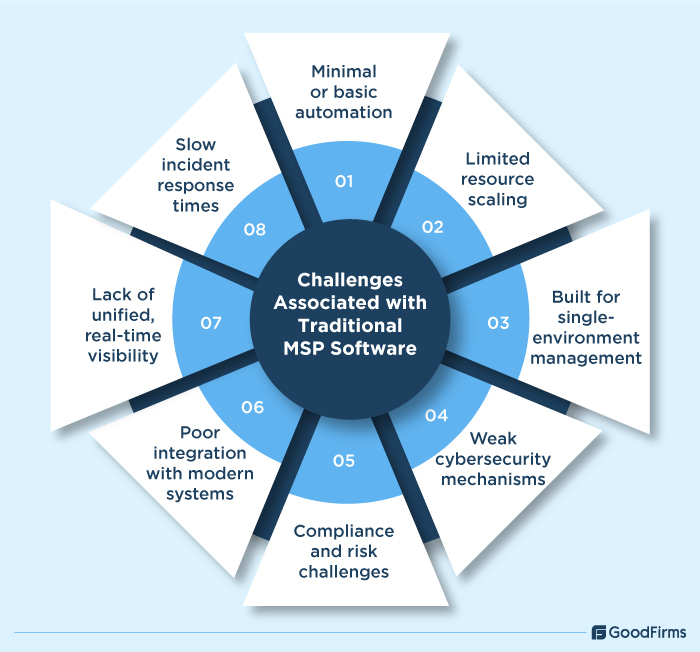
The modern business landscape is dominated by hybrid ecosystems which includes both on-premises and cloud systems. In such a scenario, managed service providers are expected to act like strategic IT partners. Rather, they themselves are struggling with several challenges due to outdated traditional MSP software solutions. Traditional managed service provider software solutions only offer basic automation features, scalability capabilities, single-environment management, weak cybersecurity functionalities, poor visibility, etc., which are not sufficient to meet the growing needs for proactive support, a dynamic digital landscape, and evolving IT needs. As a result, it is becoming difficult for the MSPs to smoothly manage, secure, and scale the IT infrastructure.
The Global Managed Services Market is also anticipated to cross 441.1 billion in 2025 with a CAGR of 11.5%. This immense growth in the managed services landscape would further lead to an increase in the number of human errors, resource scaling, digital threats, operational costs, and much more. For instance, as per the 2024 hybrid security trends report, around 76% MSPs experienced cyber attacks within the last 12 months. Among these attacked MSPs, nearly 51% saw increased costs to fix the security issues.
Traditional MSP tools lack power, intelligence, and security that are important in the present time to establish better control over the IT infrastructure. Apart from the control, they need tools that can centralize IT management, automate routine tasks, offer deep visibility into infrastructure health, ensure compliance, and do much more. In fact, as per the State of IT report, around 34% MSPs are adopting solutions that can automate tasks and ensure optimal efficiency. In addition, 34% businesses consider risk management as the top driver for AI implementation, as per The Path to AI Maturity report.
In such scenarios, switching to an AI-powered, modern MSP software could help MSPs efficiently handle their burden. MSP solutions, powered by Artificial Intelligence and Machine Learning, offer automated ticketing management, predictive maintenance, AI Copilots, smart recommendations, deep insights, etc., that enable better control and power over the IT infrastructure. In fact, 76.4% MSPs anticipate that AI is likely to contribute between 11-50% of total revenue in the upcoming 24 months.
Feature Comparison Of Traditional And Modern MSP Software Solutions
Modern MSP software solutions have been rapidly replacing traditional systems, helping managed service providers efficiently deliver their services and ensure optimal performance of IT infrastructure. The difference between both of these types of MSP tools is as follows:
|
Feature |
Traditional MSP Software |
Modern MSP Software |
|
Automation Capabilities |
Limited rule-based automation |
End-to-end intelligent automation powered by AI/ML |
|
Cybersecurity |
Manual threat detection and response |
Proactive, AI-driven threat detection and response systems |
|
Self-Healing Capabilities |
Not available |
Available via AI-driven diagnostics and automated remediation |
|
Reporting & Analytics |
Basic reporting tools with minimal insights |
Real-time analytics with customizable dashboards |
|
Smart SLA Management |
Manual SLA tracking and contract handling |
Automated SLA tracking with smart alerts |
|
Resource Allocation |
Manual assignment based on fixed rules |
Intelligent workload balancing and dynamic resource allocation |
|
Compliance & Auditing |
Static compliance tools |
Automated compliance tracking with audit trails and alerts, and role-based access |
|
Mobile & Remote Access |
Limited mobile functionality |
Fully mobile-enabled with remote monitoring and management capabilities |
How Can Modern MSPs Achieve More Power And Control with AI-Powered MSP Software?
The modern IT environment has become too complex and MSPs need enhanced tools and software solutions that can provide more power, more control, and more visibility over the complete IT infrastructure. However, not just implementation, but MSPs should also optimally leverage these advanced solutions to get full value on their investments.
Moreover, as endpoint exposure levels continue to climb with business growth in an increasingly competitive market, scaling security services is often challenging for MSPs if automation is not adopted. For this reason, MSPs are rethinking their strategies and opting for automated unified cybersecurity to drive success into the future and align with vendors.
MSPs can use below discussed tips to gain more and control as follows;
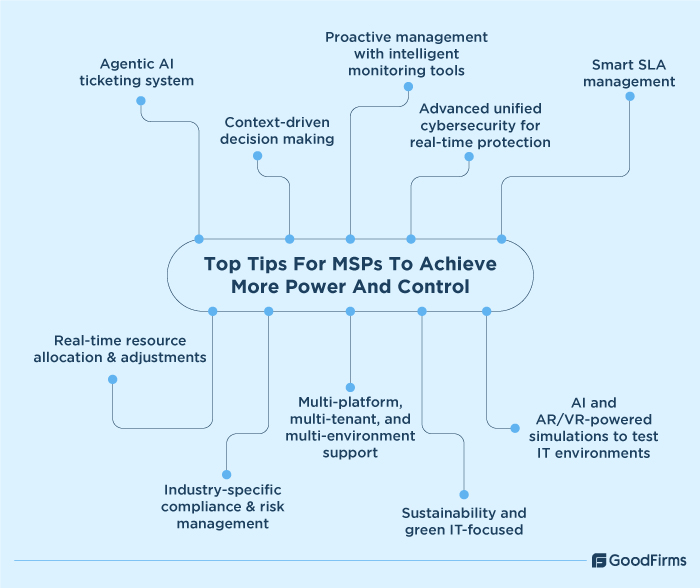
#1 Agentic AI Ticketing System
Agentic AI ticketing or AI-powered end-to-end ticketing is crucial to quickly resolve IT tickets with utmost speed, efficiency, and accuracy. Not only this, agentic AI ticketing can autonomously handle tickets at every stage, whether creation, assignment, triage, prioritization, or closure. MSP tools with features of agentic AI advanced ticketing software in the AI era can automatically generate tickets from system alerts and emails, intelligently route tickets, better understand ticket context, learn from existing data, and provide real-time ticket status, thus lowering operational costs and improving overall control. A recent report indicates that AI in ticketing can reduce ticket resolution time by 30%-35%. HCLTech, Accenture, Infosys, and Cognizant are a few top MSPs who are already leveraging AI to deliver exceptional and intelligent services.
AI MSP tools help MSPs effectively automate the responses to commonly known issues, thus reducing the call volume by 15%.
#2 Context-driven Decision Making
One of the major drivers of success for MSPs in the present competitive world is ability to make context-driven decisions. Context-driven decisions powered by Artificial Intelligence, machine learning, data analytics, logic-based engines, etc., are useful in responding intelligently to situations and events. For this, managed service providers can implement advanced MSP tools that can analyze a vast number of data points, such as system health, user behavior, historical data, current workloads, risk levels, location, compliance factors, etc., to efficiently interpret the full situation surrounding an event or request and help MSPs make better decisions.
Gen AI-powered chatbots are one of the best tools to make context-aware decisions. In fact, 63% respondents of the Capgemini’s Customer Service Transformation 2025 report stated that Gen-AI powered chatbots have become better in understanding the wider context over the last 2 years. The advanced AI-powered MSP tools are highly suitable for delivering the best suitable responses, recommending personalized solutions, prioritizing issues based on impact, and providing enhanced consultative services based on usage patterns and risk scores, resulting in faster resolutions and fewer escalations.
#3 Proactive Management With Intelligent Monitoring Tools
Another notable feature of modern MSP tools that service providers can benefit from is integrated intelligent monitoring tools. These integrated intelligent monitoring tools offer advanced functionalities, such as predictive analytics, health check ups, automated alerts, intelligent log analysis and correlation, self-healing, custom dashboards, root cause analysis (RCA) engines, etc.
MSPs can use these functionalities for real time anomaly detection, auto-remediation, downtime reduction, performance optimization, and hardware/software failure prediction, enabling proactive management of IT environments with enhanced control. According to the State of the Market for MSPs report, 72% MSPs feel automation of routine and error prone tasks is key to optimal IT monitoring. The modern MSP tools with intelligent monitoring features offer robust automation capabilities to streamline routine and time consuming tasks.
#4 Advanced Unified Cybersecurity For Real-time Protection
At present, the advancements in technology have led to a yearly increase of 30% in cyber threats. In addition, the global average cost to a data breach reached $4.9 million in 2024. In fact, cybersecurity was a major concern for 78% MSPs in the 2024 MSP Benchmark Survey, making it necessary to have MSP tools with unified security mechanisms to safely prevent cyber threats in 2025. These advanced security mechanisms include AI and ML-powered threat intelligence, advanced pattern detection, user behavior monitoring, automated incident response, zero trust network access, unified threat detection, advanced configurations management, automated patch management, etc., through which managed service providers and IT managers can proactively detect and mitigate various types of cyber threats. Intelligent MSP tools also come with features of AI-powered server management for business continuity.
As per the SaaS Alerts Research Report, businesses spend an average of 3-4 hours weekly in security monitoring and management and another 3-4 hours weekly for policy configuration management and reporting. Such excessive time and resource wastage can be significantly reduced through modern managed services tools that can automate the monitoring, management, and reporting of security issues and configurations.
Unified cybersecurity tools with advanced features have become a core necessity for the MSPs, owing to the benefits, such as proactive threat mitigation, 24*7 security coverage, faster incident response, real-time security monitoring, automated configuration management, etc. MSPs can efficiently eliminate cyber inefficiencies in reduced time and costs, meaning better agility, and confidence.
#5 Multi-platform, Multi-tenant, And Multi-environment Support
Modern times are digital and traditional on-premises systems are not sufficient to meet the business needs. 66% MSPs are shifting away from traditional on-premises models and will use hybrid management models for on-premises and cloud environments. MSPs are increasingly using a wide range of platforms, cloud environments, and organizational structures. Due to this, traditional MSP software cannot optimally manage each and every component of IT environments. To prevent such challenges, Modern MSP software with in-built multi-platform, multi-tenant, and multi-environment support capabilities can help manage different environments for different clients independently.
Such tools can centralize dashboards with client-wise views and controls, provide policy-based administration for each environment, isolate functions for each tenant, etc., thus reducing tool sprawl, bringing centralized control, and ensuring scalability. In fact, tool sprawl is a significant issue that 50% of MSPs experience, as per the IT Trends Report 2025.
#6 Real-time Resource Allocation And Adjustments
In 2025, improving resource allocation is a key resource management priority for 64% businesses, as per the State of Resource Management 2025 report. The integration of AI and automation in modern MSP software in 2025 is also useful for MSPs in dynamically allocating and adjusting IT resources. AI-powered automation capabilities offer features like live monitoring dashboards, policy-based auto-scaling rules, integration with cloud APIs, remote command execution, resource heatmaps, drag-and-drop workload reallocation, etc.
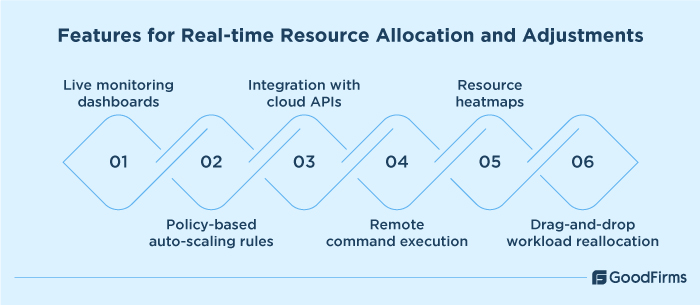
Through these features, MSP tools can analyze current workload, system demand, user behavior, performance metrics, and much more to autonomously reduce or scale the resources as per needs. For instance, if an application needs more computer power and storage for large scale processing, then the MSP tool can automatically analyze the requirements and accordingly make required provision without any manual intervention. This is also beneficial in eliminating resource wastage and performance issues, hence, ensuring cost savings.
#7 Industry-specific Compliance And Risk Management
At present, the regulatory and compliance environments across different industries and sectors are growing more complex day by day. It has become difficult for MSPs to efficiently manage the IT environments while also adhering to HIPAA, PCI-DSS, SOX, ISO, GDPR, and various other standards. As a result, complete visibility and control over compliance and regulatory functions have become tough. And, only 20% of business executives have complete visibility over their regulatory and compliance requirements, as per The 2025 State of Regulatory Affairs and Compliance report. As per another Responsible AI Maturity research, around 50% businesses do not have proper risk identification and management processes in place, which can influence their operational effectiveness in case of any occurrence of a potential risk.
Modern AI-powered MSP tools can eliminate such issues that come with tailored, sector-specific compliance functionalities, risk assessment frameworks, and automated audit trails to quickly meet industry-specific compliance and risk guidelines. Through these tools, MSPs can map endpoints, IT processes, data flows, user activity, etc., as per regulatory requirements, enabling proactive governance and risk-free operations. In fact, 36% MSPs are willing to pay up to 10% extra for better compliance functionalities in the next 12 to 24 months.
#8 Smart SLA Management
Earlier, in the traditional MSP tools, SLA tracking relied on manual models and inputs. However, with the emergence of intelligent, modern MSP tools, service providers can benefit from automated, rule-based enforcement and real-time performance tracking. These modern tools come equipped with smart SLA engines through which MSPs can define granular terms for response time, uptime, issue resolution time, escalation paths, etc. Once configured, the MSP tools can automatically track support tickets, tasks, system performance metrics, etc., in real time and accordingly map them against the SLA. This is great for reducing SLA breaches, increasing transparency, gaining high trust with clients, and ensuring greater control, agility, and reliability for MSPs.
#9 Sustainability And Green IT-focused
“Sustainability enables businesses to cope with disruption,”
- Kristin Moyer, Research Vice President & Distinguished Analyst at Gartner
As per the Digital Infrastructure Report 2024, around 58% of CIOs agree that AI has enabled the use of more on-demand/NaaS features that play a crucial role in cutting carbon emissions. Energy-efficient infrastructure monitoring, carbon footprint analytics, e-waste tracking, automated resource optimization, sustainability reports, etc., are a few of these features. Through these features, MSPs can constantly monitor and track the energy consumption in real time, allowing them to identify anomalies and inefficiencies and accordingly make smart decisions.
For instance, sustainability-based functionalities can automate sleep cycles for unused devices to minimize energy consumption when not in use. In addition, modern MSP tools make it easy to comply with and monitor EPEAT, RoHS, and Energy Star regulations to procure IT assets and hardware in an environment friendly manner. Service providers can also set automated alerts to flag assets that do not meet green IT benchmarks. MSPs that rely on these AI-powered modern tools can easily meet their ESG goals to differentiate themselves from competitors.
For example, CapGemini, an Indian managed service provider is using a modern MSP tool from Schneider Electric to reduce energy usage across its 23 campuses and 70+ buildings in India. Using the sustainability and green IT focused features of the MSP tool, the company has achieved a 29% reduction in energy consumption.
#10 AI-powered Simulations to Test IT environments
Modern MSP software solutions also allow service providers to interact with IT infrastructure in an immersive and predictive way without touching the live environment. AI-powered MSP tools come with historical data analysis, predictive algorithms, real-time analytics, etc., through which managed service providers can easily create digital replicas of model network configurations, security protocols, server workloads, and user behavior, allowing MSPs to gain deeper insights into the performance, security, and fault tolerance capabilities of IT infrastructure.
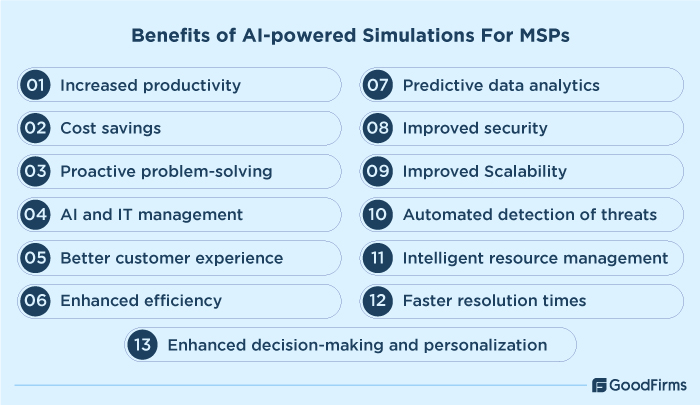
AI-powered simulations are useful in accurately creating enhanced digital twins, comprehensively testing changes and new deployments, proactively predicting outcomes, better visualizing complex infrastructure setups, and immersively training new technicians, thus enabling increased productivity, cost savings, proactive problem-solving, better customer experience, enhanced efficiency, improved security and scalability, faster resolution times, etc.
The Future Of Modern MSP Software
Currently, businesses are rapidly adopting distributed architectures and cloud-first strategies. While modern MSP tools are able to minimize several negative implications of this evolving adoption, a few challenges associated with scalability, unified visibility, complexity of hybrid architectures, lack of skilled professionals, legacy system integration, etc., are still there. These challenges are hampering the ability of MSPs to deliver agile, secure, and proactive control to clients. In fact, more than half of the MSPs are experiencing challenges due to lack of skilled professionals (51.8%) and legacy system integration (52.8%), as per the AI Adoption in Managed Services Report.
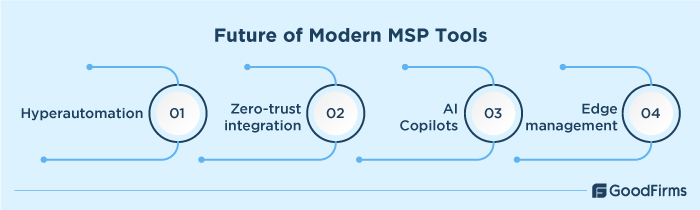
The next generation of modern MSP tools can help completely eliminate these challenges by leveraging groundbreaking technologies and architectural shifts. Upcoming advancements in terms of edge management, zero-trust integration, AI Copilots, hyperautomation, etc., can completely transform MSPs operations. For instance, edge management will enable real time monitoring and remediation of edge devices, Zero-trust integration will bring maximum security to multi-cloud, hybrid and BYOD environments, AI Copilots will act as intelligent support assistants that can auto analyze issues, predict system failure, configure assets and auto-generate reports, and hyperautomation will enable end-to-end workflow orchestration, allowing MSPs to become true enabler of digital transformation.
Conclusion
The managed services landscape is rapidly evolving, driven by a strong need to proactively manage and monitor IT infrastructure. In such conditions, modern MSP software solutions do not just act as a support tool. Rather, they offer a powerful suite of advanced features and functionalities to efficiently scale, secure, and automate IT infrastructure management. From AI-powered ticketing and intelligent monitoring to smart SLA management, sustainability, and immersive simulation environments, modern MSP tools are helping companies deliver superior outcomes in a cost-friendly manner. With the ever-increasing digital ecosystem complexities, there is a dire need for MSPs to rethink their strategies and shift to AI-powered, modern MSP software that promises more power, more control, and more potential.