Key takeaways
- Customer success software is proactive, while customer support software is reactive.
- The right affordable tool depends on your team size, customer volume, and CS maturity.
- HubSpot is the best free starting point for small teams that want to manage customer relationships without a dedicated CS platform.
- As your team and customer base grow, dedicated tools like Custify, Vitally, and Hook offer deeper health scoring and automation.
Free customer success software is harder to find than free customer support (CS) software. Most genuinely free options are CRM or help desk platforms, while dedicated CS platforms primarily charge for health scoring, automation, and account-level analytics.
Ready to compare more options? Browse Goodfirms' full list of customer success software, with verified reviews and ratings from real teams.
We compared eight free and affordable options for 2026 to identify which ones actually make sense for small teams, growing SaaS companies, and budget-conscious CS teams.
Best Free and Affordable Customer Success Software at a Glance
|
Tool |
Starting price |
Free plan |
Best for |
Dedicated CS? |
|---|---|---|---|---|
|
HubSpot Service Hub |
Free |
Yes (2 users, no expiry) |
Teams already on HubSpot CRM |
No |
|
Zoho Desk |
Free |
Yes (3 agents, no expiry) |
Teams inside the Zoho ecosystem |
No |
|
Custify |
~$899/month |
No |
Small SaaS teams, 2-10 CSMs |
Yes |
|
Vitally |
~$499/month |
14-day trial |
Mid-market teams needing speed |
Yes |
|
Hook |
~$500/month |
No |
AI-first predictive signals |
Yes |
|
ZapScale |
~$599/month |
Free trial |
Health-score depth on a budget |
Yes |
|
ClientSuccess |
~$1,625/month (median) |
No |
Startups outgrowing free tools |
Yes |
|
Userpilot |
$299/month |
No |
SaaS teams tracking in-app behavior |
Adjacent |
Pricing note: Vendor pricing changes frequently. Where a company does not publish a public rate card, prices shown are third-party estimates or procurement data and should be confirmed with the vendor before purchase.
Customer success software and customer support software may sound similar, but they serve different purposes. Customer support tools are typically reactive: they manage tickets, answer questions, troubleshoot issues, and help customers resolve problems when they arise. Customer success software, on the other hand, takes a more proactive approach: it monitors product usage, engagement, and account health to identify risks and opportunities. Instead of waiting for a customer to raise a ticket, customer success teams can use these insights to improve adoption, prevent churn, strengthen relationships, and help customers achieve better outcomes.

You can focus on adoption, retention, expansion, or advocacy; or you can focus on the customers' desired outcome and get all of those things.
- Lincoln Murphy, VP of Customer Experience, Listkit
That's the proactive mindset customer success software is built to support.
The proactive-versus-reactive distinction matters most when you're shopping on a budget — a free help desk plan gives you ticketing and a shared inbox, but it won't tell you a customer's usage dropped 40% last week or that a renewal is at risk.
The breakdown below shows which tools are genuinely free and which are simply priced for smaller teams. We will now take a closer look at what each tool offers.
8 Best Free and Affordable Customer Success Software in 2026
These eight tools cover the realistic range for a budget-conscious team: two genuinely free options built for support-adjacent use cases and six dedicated or CS-adjacent platforms priced for teams without an enterprise budget. This list skips the enterprise tier entirely — names like Gainsight or ChurnZero, where annual contracts routinely start in the five figures — because that's not what someone searching for affordable or free options is shopping for.
1. HubSpot Service Hub — Best Free Option Overall
HubSpot's free CRM includes Service Hub tools with ticketing, a shared inbox, live chat, and basic bots at no cost. They are attached to the same contact record that your sales and marketing teams already use. HubSpot CRM is not a dedicated health-scoring engine, but you can build custom properties to track usage or renewal dates manually, and it remains free indefinitely rather than expiring. If live chat is your main requirement rather than a bonus feature, Goodfirms' reviews of live chat software cover tools built specifically for that.
- Pricing: Free forever for up to 2 users (no credit card, no expiration date). If you outgrow that, paid tiers start at Starter ($15/seat/month), Professional ($50/seat/month), and Enterprise ($75/seat/month), billed annually.
|
Pros |
Cons |
|---|---|
|
Free forever, not a countdown trial |
No built-in health scoring; you build it yourself with custom properties |
|
Every ticket and chat attaches to the CRM contact automatically |
Real automation and the AI agent sit behind paid tiers |
|
No separate tool to learn if you already run HubSpot for sales or marketing |
Free tier caps at 2 users — a third CSM forces an upgrade |
2. Zoho Desk — best free option inside an existing suite
Zoho Desk's free-forever plan covers up to 3 agents with email ticketing and a help center, and it links natively to Zoho CRM, so account history sits next to every conversation without extra setup. For a team already using Zoho apps, it is the lowest-friction way to start tracking customer health without a new login.
- Pricing: Free forever for 3 agents. If you outgrow that, paid tiers start at Express: $7/agent/month; Standard: $14/agent/month; Professional: $23/agent/month; and Enterprise: $40/agent/month, billed annually.
|
Pros |
Cons |
|---|---|
|
Genuine free-forever plan, not time-limited |
Live chat and the Zia AI assistant require the Enterprise tier |
|
Native Zoho CRM link shares customer history automatically |
Built for ticketing first, health scoring second |
|
Cheapest paid tiers in this entire list if you outgrow free |
Automation rules are limited on free and lower-paid tiers |
3. Custify — best affordable dedicated platform for small SaaS teams
Custify is the platform CS leaders point small teams to when they want an actual customer success platform rather than a repurposed help desk. It pulls together product usage, support tickets, CRM data, and billing into a single account view, with a configurable health score and a visual playbook builder for automated outreach.
- Pricing: Published third-party pricing trackers put Custify starting around $899/month, though the vendor does not publish an official rate card, so confirm current figures directly with sales.
|
Pros |
Cons |
|---|---|
|
Purpose-built for CS, not a repurposed support tool |
Setup requires clean data and planned health-score logic upfront |
|
Replaces the habit of opening five tools before every customer call |
Reporting depth has limits for management-level analysis |
|
Fast, responsive support team called out consistently in reviews |
The playbook builder has a learning curve and a slow setup |
4. Vitally — best for mid-market teams that need to move fast
Vitally combines project-management-style workflows with customer success tracking. It is the platform most often recommended for teams that want to be live in weeks rather than a full quarter. Its Tech-Touch tier is built for one-to-many, product-led teams that don't need the full high-touch feature set.
- Pricing: Quote-based — Vitally's pricing page doesn't list rates for any tier. Third-party trackers estimate entry pricing around $499/month. At the same time, Vendr procurement data indicate that the median annual contract is $38,987 once teams move to higher tiers, so entry pricing and typical spend can diverge quickly.
|
Pros |
Cons |
|---|---|
|
Among the fastest implementations in the category, roughly 2–3 weeks |
Analytics depth trails Gainsight or ChurnZero for complex calculations |
|
Highly customizable dashboards that match how CSMs already work |
Performance can lag with very large account datasets |
|
AI Copilot and meeting recorder are consistently praised as time-savers |
Dashboard customization can feel overwhelming without a clear plan |
5. Hook — best for AI-first health signals on a budget
Hook leans entirely into predictive analytics: it is built to flag churn risk and expansion signals early, with less manual configuration than most platforms in this price range. It suits small teams with a strong data culture that would rather lean on AI scoring than build a health formula from scratch.
- Pricing: Starts at around $500/month, according to third-party procurement trackers; confirm current pricing directly, as the vendor does not publish a public rate card.
|
Pros |
Cons |
|---|---|
|
Predictive signals with minimal setup compared to configurable-scoring platforms |
Depends on clean, connected data sources to be useful out of the gate |
|
Strong fit for small teams without a dedicated CS Ops resource |
Smaller ecosystem and fewer public case studies than the bigger names |
|
Sharper early-warning precision than most tools at this price point |
AI-driven scoring leaves little room for manual overrides |
6. ZapScale — best for health-score depth without enterprise pricing
ZapScale pulls in roughly 150 data points across six data sources to build what it calls an evidence-based health score, aiming to remove the guesswork that comes with a simpler, manually weighted formula. It ships with ready-made KPIs and playbooks, which shortens setup for teams without a CS Ops function to build that logic themselves.
- Pricing: Third-party listings list ZapScale starting at around $599/month; a free trial is available, but full pricing is behind a demo request.
|
Pros |
Cons |
|---|---|
|
Health score draws on far more data points than most affordable tools |
Newer entrant with a smaller review base than established players |
|
Ready-made KPIs and playbooks reduce initial setup work |
Full pricing isn't public, so budgeting requires a sales conversation |
|
Easy setup and support are consistently flagged as smooth in reviews |
Narrower integration list than more established platforms |
7. ClientSuccess — best next step up for a growing team
ClientSuccess sits just above entry-level tools in price, but maintains the fast-adoption, low-friction philosophy that makes it a common pick for startups outgrowing spreadsheets and free tools. Its Client 360 dashboard and SuccessScores provide a fuller picture than Custify or Vitally's entry tiers, at a cost that is still a fraction of Gainsight's or Totango's.
- Pricing: Quote-based; Vendor procurement data puts the median annual contract at $19,500, with a typical range of $5,781 to $30,750 plus implementation fees of $5,000–$20,000.
|
Pros |
Cons |
|---|---|
|
Low adoption friction; CSMs are productive within days |
Best suited to teams that already understand their CS process |
|
Custom fields let teams track what actually matters to their business |
Success cycles are linear, which creates friction for non-standard accounts |
|
Meaningfully cheaper than Gainsight, ChurnZero, or Totango at this stage |
Implementation fees ($5,000–$20,000) add to year-one cost |
8. Userpilot — best for SaaS teams where in-app behavior is the health signal
Userpilot isn't a customer success platform in the traditional sense; it's a product growth tool that CS teams increasingly use because in-app behavior often tells you more about account health than a CRM field ever will. It enables teams to build onboarding flows, checklists, and tooltips without engineering, then track feature adoption and retention through built-in analytics.
- Pricing: Starter begins at $299/month (3 seats), covering in-app engagement, NPS surveys, and basic segmentation; Growth adds analytics, autocapture, and A/B testing; Enterprise adds data warehouse sync and SSO.
|
Pros |
Cons |
|---|---|
|
Removes the engineering dependency for onboarding changes — CS and product teams ship flows themselves |
At $299/month minimum, it's priced above the lighter tools on this list and isn't a full CS platform on its own |
|
Feature-level usage data feeds directly into health scoring, which most affordable CS platforms can't replicate |
Reporting customization and data export are recurring friction points; heatmaps aren't available |
|
Fast, responsive support consistently flagged as a differentiator in reviews |
No native ticketing or health scoring — needs a companion tool |
Goodfirms Take
Every genuinely free tool on this list — HubSpot Service Hub, Zoho Desk — comes from a support or CRM company, not a dedicated customer success company. Their free tiers can support basic CS workflows. None of the purpose-built CS platforms here (Custify, Vitally, Hook, ZapScale, ClientSuccess) offer a free tier. If a "customer success" tool offers a permanent free plan, that's usually a sign that health scoring isn't really the product — it's a side feature bolted onto a support or CRM tool.
Before you pick one from the list above, it helps to know what factors go into making a good deal from a tool that's just cheap.
What Should You Look for in an Affordable Customer Success Tool?
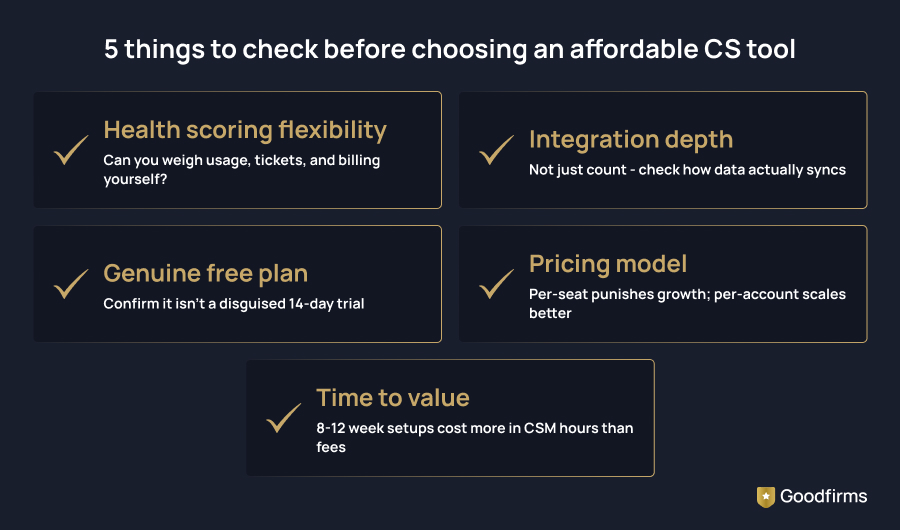
Cheap and free options have their fair share of drawbacks. If you pick a tool that trims the right things, then you are fine. But if you pick a tool that trims the wrong things, you’re rebuilding your stack in six months
1. Health scoring flexibility
Can you decide what counts most toward a customer's health score — usage, support tickets, or billing? Or does the tool force one fixed formula on everyone? A rigid formula works fine at first, but it's usually the first thing teams outgrow as their business changes.
2. Integration depth, not just integration count
A vendor might have a list of 50 integrations, but they won’t provide much value if your CRM connection requires manual CSV exports. So, it is necessary to ask specifically how your CRM, billing system, and product analytics tool sync, and how often they do so.
3. Genuine free plan vs. a disguised trial
Some "free" customer success tools offer just 14-day free trials. One must check whether the free tier actually expires before you build a workflow around it.
4. Pricing model
Some tools charge based on the number of customer support managers you hire, so your bill grows with each hire. Some charge by account count or active users, so costs depend on the customer base rather than your headcount. It is essential to know which one you're signing up for before you commit.
5. Time to value
If a tool takes 8–12 weeks to set up, the real cost isn't the subscription — it's all the CSM hours spent getting it running. That adds up fast at a small company, where no one has the job of managing the setup full-time.
Keeping these factors in mind, the real question isn't which tool has the best features — it's where your team actually stands right now.
Which Customer Success Software Should You Choose?
Small SaaS businesses have real reason to take this seriously: companies with under $10 million in revenue see churn rates of 20% or more annually, compared to roughly 8.5% for larger SaaS companies. At that rate, catching even a handful of at-risk accounts early — the exact job health scoring is built for — can be the difference between a growing base and a shrinking one.
|
Your situation |
Best starting point |
|---|---|
|
1–3 CS users, very small customer base |
HubSpot |
|
Already use Zoho |
Zoho Desk |
|
Leaving spreadsheets |
Custify |
|
Want AI-driven health signals |
Hook |
|
Need deeper health scoring |
ZapScale |
|
100+ accounts and fast implementation |
Vitally |
|
Growing CS operation |
ClientSuccess |
|
Product adoption is your main health signal |
Userpilot |
If your CS team has fewer than 5 people and fewer than 100 accounts, stay in your CRM. HubSpot Service Hub or Zoho Desk, paired with a manually built health-scoring spreadsheet, is genuinely defensible at this size. A dedicated platform is easy to underuse when there's no one whose job is to own it, and an underused platform delivers close to zero return regardless of price.
If you're a small SaaS team ready to quit spreadsheets, Custify or Hook is the natural next step: fast setup, solid health scoring, and pricing that won't need a six-figure budget conversation. Go with Custify if you want to configure the scoring yourself, or Hook if you want AI to handle the predictions with less manual work.
If you're scaling beyond 100 accounts and need speed, Vitally's 2–3-week implementation and flexible dashboards make it the most common recommendation for mid-market teams that need to go live quickly without a dedicated CS Ops hire to manage the rollout. ZapScale is worth a look if health-score depth matters more to you than implementation speed.
Sometimes the real fix is simpler than a dedicated CS platform.
What Tools Can You Use Instead of Dedicated Customer Success Software?
General-purpose tools — Freshdesk for ticketing, Trello/Asana/ClickUp for onboarding, and Notion/Workona for documentation — can solve specific CS bottlenecks without a dedicated platform.
Not every CS problem needs a CS platform. If your bottleneck is more specific, one of these general-purpose tools may solve it faster and cheaper.
Freshdesk handles support ticketing, not health tracking. It is useful if your real pain point is an overflowing inbox rather than churn risk. Its free plan covers 2 agents for 6 months. If ticketing is the priority, Goodfirms' ratings of help desk software cover more options.
Trello, Asana, and ClickUp aren't CS software, but their free tiers and onboarding templates work well for teams whose real problem is "new customers get lost in week one." See Goodfirms' comparisons of project management software for more.
Notion and Workona solve scattered documentation instead — organizing files, notes, and account context in one place, which often helps CSM efficiency more than any other dashboard. Goodfirms' reviews of knowledge management software and systems for 2026 are a good next stop.
Freshdesk, Trello/Asana/ClickUp, and Notion/Workona can't replace a dedicated health-scoring platform once churn prevention becomes the actual job — but they're an honest starting point until then. Whichever route you go with, it's worth taking a step back to see how it all adds up.
Bottom Line: Which Customer Success Software Is Right for You?
Affordable customer success software in 2026 splits into two categories: genuinely free tools you already half-own through your CRM, and dedicated platforms priced from roughly $299 to $1,625 a month that do health-scoring and automation work a spreadsheet can't. Neither should be confused with full enterprise-grade suites, in which annual contracts often exceed $50,000 before implementation. Match your team's size and maturity to the tool, and the price tag tends to make sense on its own. A few questions come up often enough to answer directly.
FAQs: Free Customer Success Software (2026)
What's the difference between CRM, customer success software, and customer support software?
A CRM tracks the full customer relationship — contacts, deals, and communications. Customer support software is reactive, resolving issues after a customer files a ticket. Goodfirms' list of customer service software covers the top tools in that space. Customer success software, on the other hand, is proactive, monitoring usage and engagement signals to catch at-risk accounts before a ticket is ever filed.
What is the best affordable customer success software?
For small teams without a dedicated CS budget, HubSpot CRM is the most practical starting point — not because it's a true CS platform, but because it's free and lets you manually track account health using custom properties. (For dedicated CRM options at this stage, Goodfirms' reviews of CRM software are worth a look.) Once you outgrow that setup, it depends on your bottleneck: Zoho Desk or Freshdesk for ticketing; Trello/Asana/ClickUp for onboarding; Notion or Workona for documentation; and Userpilot for in-app behavior tracking.
Is there truly free customer success software?
Yes. HubSpot Service Hub and Zoho Desk both offer genuine free-forever plans, not time-limited trials. Neither does health scoring out of the box, though — you'll need to build that yourself.
Which is the most affordable dedicated customer success platform?
Among the tools compared here, third-party estimates place Vitally and Hook near the $500/month range, while Custify is higher. Because these vendors use quote-based pricing, confirm the current cost directly before making a decision.
Should a small team use a CRM or a dedicated CS platform?
For fewer than 5 people and 100 accounts, a CRM with manually tracked signals is enough. Above that, a dedicated platform usually pays for itself in CSM efficiency within six months.