Key takeaways
- Not every "AI" marketing automation platform is genuinely AI-driven; many just run on a fixed schedule with an AI label attached.
- These platforms split into three types: ecommerce-first (Klaviyo, Omnisend), SaaS-first (Customer.io, Encharge), and all-in-one CRM-plus-marketing (HubSpot, EngageBay).
- A predictive send-time or lead score is a probability, not a guarantee.
- Pricing scales with list size, not team size. Check the cost at double your current size before signing up.
- Verify integrations and pricing on the vendor's actual page; marketing pages oversell both.
Every startup's marketing starts in the same way: a spreadsheet, a shared inbox, and a promise to follow up tomorrow. It works smoothly for a while. Then, as your lead count starts growing faster than your team can handle, tomorrow never actually comes.
That's exactly the problem the best marketing automation software for startups is built to solve. Not the bulky, enterprise tools made for teams with a whole ops department, but ones built for a founder running sales, marketing, and support all at once.
Already have leads piling up? Compare vetted marketing automation software on Goodfirms, or check email marketing software if you just want your campaigns out the door first.
So here are 10 AI marketing automation tools built for startups in 2026, picked for what actually matters at your stage: budget, setup time, and team size, not brand name. You'll see exactly where the "AI" changes something real, and where it's just a sticker slapped on an old feature.
What is AI Marketing Automation Software?
AI marketing automation software is a platform that uses machine learning to automatically trigger, personalize, and optimize marketing campaigns based on real-time customer behavior rather than fixed, preset rules.
It typically covers:
- Lead scoring: ranks contacts by how close they are to buying
- Behavioral segmentation: groups contacts by actions, not demographics
- Automated email workflows: sends triggered by behavior, not a calendar
- Cross-channel campaign management: email, SMS, and ads run from one dashboard
- CRM sync: sales and marketing work off the same customer data
AI Marketing Automation Software Comparison
The right marketing automation software for startups depends less on which platform offers the most features and more on which one aligns with your team size, channels, and budget. This table breaks down the ten platforms covered below into exactly those terms.
|
Tool |
Best For |
Key Features |
Pricing |
|---|---|---|---|
|
HubSpot |
Startups want CRM and marketing in one system |
CRM, email automation, landing pages, lead scoring |
Free plan; Starter from $15-20/seat/mo; Professional from ~$890/mo |
|
ActiveCampaign |
Startups wanting deep automation without enterprise pricing |
500+ automation triggers, predictive sending, win-probability scoring |
Starter from $15/mo; Plus $49/mo; Pro $79/mo; Enterprise $145/mo |
|
Klaviyo |
Ecommerce and DTC startups |
Predictive analytics, behavioral segmentation, email + SMS |
Free up to 250 profiles; Email starting from $20/mo; mobile messages $35/mo based on selection |
|
Mailchimp |
Startups wanting a familiar, low-cost entry point |
Behavioral targeting, customer journey builder, and AI content tools |
Free (250 contacts); Essentials $13/mo; Standard $20/mo |
|
Brevo |
Budget-conscious startups needing email, SMS, and light CRM |
Volume-based pricing, built-in CRM, multi-channel automation |
Free (unlimited contacts, 300 emails/day); paid from ~$8/mo |
|
Customer.io |
SaaS and product-led startups running behavior-triggered messaging |
Event-triggered workflows, deep segmentation, multi-channel journeys |
Essentials from $100/mo |
|
Omnisend |
Ecommerce startups wanting Klaviyo-level automation for less |
Email, SMS, and push in one workflow; prebuilt ecommerce automations |
Free plan; Standard from $11/mo; Pro from $41/mo |
|
MailerLite |
Early-stage startups needing simple email automation |
Basic automation, landing pages, A/B testing |
Free (up to 250 subscribers); paid from ~$10/mo |
|
EngageBay |
Startups want CRM and marketing automation bundled cheaply |
Unified CRM/marketing/helpdesk, lead scoring, email sequences |
Free (250 contacts); Basic from $11/user/mo; Growth $42/user/mo |
|
Encharge |
SaaS startups automating on product usage, not just email opens |
Behavior-based flows, native SaaS integrations (Stripe, Segment), and a visual builder |
Growth from $79/mo (2,000 subscribers) |
How Much Does Marketing Automation Software Cost in 2026?
Most marketing automation software for startups falls into one of three pricing tiers. Entry-level tools such as Brevo, MailerLite, Omnisend, and Mailchimp start between $8 and $20 per month, making them suitable for early-stage startups validating their marketing channels. Mid-tier platforms such as ActiveCampaign, Encharge, and EngageBay typically range from $40 to $100 per month, offering more advanced automation, CRM integration, and behavioral targeting. Enterprise-focused platforms such as HubSpot Professional and Customer.io Premium can cost $890 to $1,000+ per month, with additional onboarding or implementation costs in some cases. Pricing generally scales with contact volume, usage, or feature access rather than team size.
Pricing Summary Table:
|
Pricing Tier |
Typical Monthly Cost |
Tools |
|---|---|---|
|
Free/Entry-level |
Free - $20/month |
Mailchimp, Brevo, MailerLite, Omnisend |
|
Growth Stage |
$20 - $100/month |
ActiveCampaign, Klaviyo, Encharge, EngageBay |
|
Advanced/Enterprise |
$890 - $1000/month |
HubSpot Professional, Customer.io Premium |
Startup budgeting tip: Don't evaluate a platform solely on its starting price. Most marketing automation vendors increase costs as your contact list grows, so compare pricing at both your current size and your projected size in 6 to 12 months. This is especially important for contact-based pricing models.
Why Marketing Automation Matters for Startups
Marketing automation matters for startups because it enables them to automate repetitive tasks that would otherwise require hours of manual effort. Now, with automation, even 2-3 people can run follow-up, segmentation, and lead-nurturing campaigns that would otherwise require a dedicated marketing team.
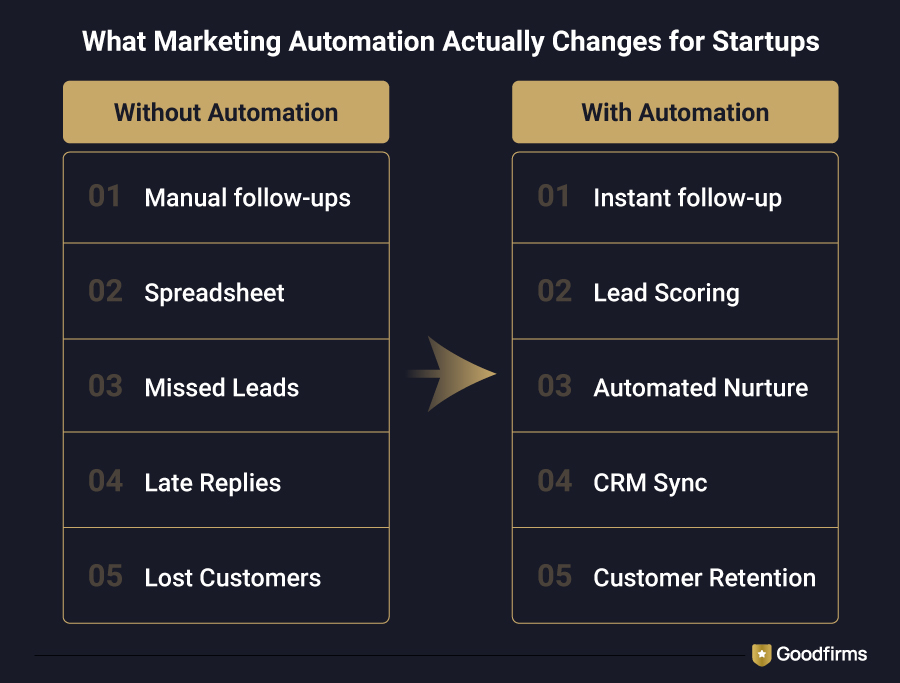
Manual Lead Follow-Up
When one or two people handle both sales and marketing, consistently following up with every lead becomes difficult at higher volumes. This is the right place where startup marketing automation tools handle automated nurturing, lead scoring, and ranking them by priority; otherwise, lead generation software usually needs a dedicated hire to run manually.
Delayed Marketing Hire
Marketing automation solutions for startups take on execution work, including customer segmentation, lead scoring, and running email workflows that would otherwise need a dedicated marketing hire, letting a startup delay that headcount without losing the function.
Investor-Ready Funnel Data
At the fundraising stage, investors ask about CAC, conversion rates, and the performance of sales funnel automation. A spreadsheet-driven process produces inconsistent data; automation tracks it as a byproduct of running campaigns.
One Person, Three Roles
Early-stage teams often have one person handling demos, follow-ups, and the CRM. Tight CRM software integration and automating the repetitive parts free that person for conversations that actually need a human.
Lifecycle Retention
A startup with 50 customers can't absorb churn as easily as an enterprise with 50,000 customers can. This is where customer engagement software built into these platforms - onboarding sequences, renewal reminders, win-back campaigns supports customer retention without manual tracking.
For a startup business, this isn’t about following a trend; it’s about saving the hours a manual process was quietly costing, at a stage when those hours matter most.
AI vs. Traditional Marketing Automation
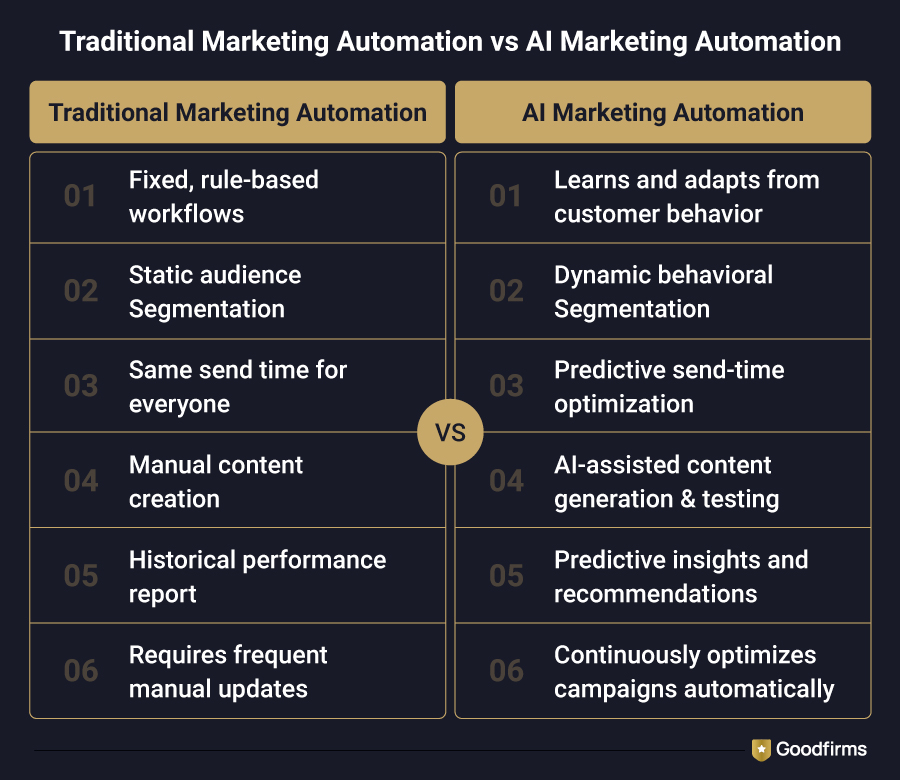
The core difference is that traditional marketing automation runs on fixed, pre-set rules. In contrast, AI marketing automation software for startups adjusts its own behavior based on real customer data as campaigns run. Read further to understand the difference in more detail:
Rule-Based vs Adaptive Workflows
Traditional marketing automation follows predefined rules, meaning every customer receives the same sequence unless someone manually changes it. AI marketing automation continuously analyzes customer interactions and automatically adjusts workflows based on real-time behavior.
Static vs Behavioral Segmentation
Traditional platforms group customers using fixed attributes such as location, industry, or signup date. AI-powered platforms create dynamic segments by analyzing browsing behavior, purchase history, engagement levels, and other real-time actions.
Historical Reporting vs Predictive Analytics
Traditional automation mainly reports what has already happened, such as email opens or conversions. AI goes a step further by identifying future opportunities and risks, including churn prediction, lead quality, and conversion likelihood.
Best AI Marketing Automation Tools
In this section, we have covered the best free, premium, and open-source marketing automation software that covers the range of what startups actually need, from simple email to full behavior-based automation. Pricing, features, and fit vary a lot between them, so it's worth reading through each before deciding. Here's a closer look at what each one offers.
1. HubSpot Marketing Hub: Best for CRM and marketing in one system
HubSpot unifies CRM software and marketing automation under a single shared contact record, so sales and marketing never work from different data. Its Breeze AI layer adds lead scoring and content assistance on top of that existing base. Founded in 2006, it has grown from a startup-friendly inbound tool into one of the most recognized names in marketing software. Today, it serves everyone from solo founders on the free tier to enterprise teams running the full Customer Platform.
On Goodfirms, HubSpot Marketing Hub holds a 4.4/5 rating across 14 verified reviews, with reviewers most often flagging steep price increases past the free tier as the main drawback.
Key Features:
- Built-in CRM with shared contact records across sales and marketing
- Multi-step email workflows and campaign management
- AI-assisted lead scoring and email personalization
- Landing pages and unified reporting
Pricing:
- Free: Free up to 2 users
- Starter: $15-20/seat/month
- Professional: $890/month
- Enterprise: $3,600/month
Pros:
- Free tier is genuinely usable, not a crippled trial
- CRM integration keeps sales and marketing on shared data
- Scales into Sales Hub and Service Hub without switching platforms
Cons:
- Workflow automation is locked out of Free and Starter plans
- Professional/Enterprise onboarding fees are mandatory and non-refundable
Why it's best for startups: HubSpot works well when a founder wants marketing automation solutions bundled with a real CRM, not two separate tools. It's a weaker fit for a team that just needs cheap email sends with no CRM ambitions.
2. ActiveCampaign: Best for deep automation without enterprise pricing
ActiveCampaign ships over 500 automation triggers, treating workflow automation as its core product rather than an add-on. Its AI layer adds predictive send-time optimization and win-probability scoring. Founded in 2003, it has built a loyal SMB following specifically around automation depth rather than template design. It now serves well over 180,000 businesses across email, sales CRM, and multi-channel messaging.
Key Features:
- 500+ automation triggers with conditional branching
- Predictive send-time optimization
- Win-probability scoring on the built-in sales CRM
- SMS and WhatsApp support on higher tiers
Pricing
- Starter: $15/month (1,000 contacts)
- Plus: $49/month
- Pro: $79/month
- Enterprise: $145/mo
Pros:
- Automation depth rivals platforms costing multiples more
- Contact-based pricing keeps the entry cost low
- Strong sales funnel automation and multi-step lead nurturing
Cons:
- Pricing climbs fast past 5,000-10,000 contacts
- Real learning curve for new users building workflows
Why it's best for startups: ActiveCampaign suits a startup that's outgrown basic broadcast email and needs genuine behavioral workflows. It's usually the first serious automation upgrade once lead scoring and nurturing actually matter.
3. Klaviyo: Best for e-commerce and DTC startups
Klaviyo pulls purchase history and browsing behavior directly from a store's platform to power predictive analytics and customer segmentation. That gives it a real edge for customer journey automation built on transaction data. Founded in 2012 and built natively around Shopify, it has become the default automation layer for a large share of DTC brands. It now supports tens of thousands of e-commerce stores worldwide.
Key Features:
- Predictive analytics for CLV and churn risk
- Deep behavioral targeting and segmentation
- Integrated product recommendation blocks
- Combined email and SMS in one workflow
Pricing:
- Free: up to 250 profiles, 500 email sends/month
- Email: from $20/month (251-500 profiles)
- Email + SMS: from $35/month
Pros:
- Ecommerce integrations go deeper than most competitors
- Strong prebuilt flows for cart recovery and post-purchase sequences
- The free plan is workable for early validation
Cons:
- Pricing scales fast with profile count: $20/mo at 500 profiles to several hundred by 20,000
- SMS billed separately, not bundled
Why it's best for startups: Klaviyo is the clear pick when purchase behavior is the actual marketing signal driving a startup's campaigns. It's a poor fit for a B2B or SaaS startup without a storefront to generate that data.
4. Mailchimp: Best for a familiar, low-cost entry point
Mailchimp pairs its original template-driven core with a customer journey builder and AI-assisted copywriting. Its most useful behavioral features are available only with the Standard plan. Founded in 2001, it remains one of the most widely recognized names in email marketing, often the first tool a founder has ever used. It now serves millions of small businesses globally.
Key Features:
- Customer journey builder with branching logic
- AI content generation
- Behavioral targeting (Standard tier and above)
- 130+ email templates
Pricing:
- Free: 250 contacts
- Essentials: $13/month
- Standard: $20/month
- Premium: $350/month
Pros:
- Lowest learning curve on this list
- The standard tier is competitive against Brevo and ActiveCampaign at low contact counts
Cons:
- Free plan cut to 250 contacts/500 sends as of 2026; automation removed entirely.
- Becomes one of the pricier options past ~10,000 contacts
Why it's best for startups: Mailchimp is a good choice for startups looking for a familiar, easy-to-learn platform for straightforward campaigns. It's worth comparing against Brevo before committing, since the price gap widens as the list grows.
5. Brevo: Best for budget-conscious startups needing email and SMS
Brevo prices on email volume sent rather than contacts stored, favoring a startup with a large list but moderate sending cadence. It bundles email marketing software, SMS, WhatsApp, and a light CRM into one plan. Formerly known as Sendinblue and founded in 2012, it rebranded in 2023 to reflect its expansion beyond email. It's based in the EU and now serves several hundred thousand businesses worldwide.
Key Features:
- Volume-based pricing, no charge for unsubscribed/duplicate contacts
- Built-in CRM
- Multi-channel automation (email, SMS, WhatsApp)
- EU-based data residency
Pricing:
- Free: unlimited contacts, 300 emails/day
- Starter plan: from $8.08/month
- Standard plan: from $16.17/month
- Professional plan: $449.08/month
- Enterprise: custom price
Pros:
- Genuinely affordable at scale due to volume-based pricing
- CRM and omnichannel marketing bundled in, not sold as add-ons
Cons:
- Template library and interface polish trail Mailchimp's
- Free plan caps at 300 emails/day
Why it's best for startups: Brevo fits a budget-conscious startup with a growing list that isn't sending daily campaigns. It's a common landing spot for teams migrating away from Mailchimp once contact-based pricing becomes expensive.
6. Customer.io: Best for SaaS teams running behavior-triggered messaging
Customer.io reacts to real product events, such as a feature being used or a trial milestone being hit, rather than running scheduled broadcasts. That makes it a strong pick for marketing automation software for SaaS startups. Founded in 2012, it built its entire architecture around event data rather than email lists from the start. It's since become a standard choice among product-led SaaS companies.
Key Features:
- Event-triggered workflows tied to product usage
- Object-based data modeling
- Deep behavioral segmentation
- Multi-channel journeys (email, SMS, push, in-app)
Pricing:
- Essentials: from $100/month (5,000 profiles)
- Premium: from $1000/month
- Enterprise: Custom price
Pros:
- Exceptionally strong for product-led growth teams tracking usage events
- Segmentation logic goes deeper than generalist competitors
Cons:
- Entry pricing is higher than most tools on this list
- Assumes a technically capable team comfortable with wiring up event data
Why it's best for startups: Customer.io is a good fit for a SaaS startup with at least one technical marketer or engineer who can connect product events to the platform. It's overkill for a team that just needs simple email sequences.
7. Omnisend: Best for ecommerce startups wanting a cheaper Klaviyo alternative
Omnisend bundles email, SMS, and push into a single workflow builder with prebuilt ecommerce automation templates ready to activate. Founded in 2014, it positioned itself early as the budget-conscious alternative to larger ecommerce platforms. It has since built a strong following among smaller Shopify and WooCommerce stores. Its free plan keeps the full feature set intact, unlike most competitors.
Key Features:
- Unified workflows across email, SMS, and push
- Prebuilt automation templates (cart recovery, welcome series)
- Full feature access on every tier, including free
Pricing:
- Free: 500 monthly emails and 250 contacts
- Standard: from $11.20/month
- Pro: from $41.30/month
Pros:
- Every plan gets the complete feature set, unlike Klaviyo's tiered gating
- Noticeably cheaper than Klaviyo under ~25,000 contacts
Cons:
- Predictive analytics is less sophisticated than Klaviyo's
- Built specifically for ecommerce, weak fit outside that category
Why it's best for startups: Omnisend suits an early-stage ecommerce startup that wants Klaviyo-style automation without Klaviyo's pricing structure. It's usually the direct comparison worth running before choosing either.
8. MailerLite: Best for early-stage startups needing simple email automation
MailerLite stays deliberately simple: email campaigns, basic automation, and landing pages aimed at founders who don't need a full startup marketing tech stack yet. Founded in 2010, it built its reputation on ease of use rather than feature breadth. It remains especially popular among solo creators and very early-stage teams. Its free tier is one of the more generous ones covered here.
Key Features:
- Basic automation workflows
- Landing page builder
- Built-in A/B testing
- Drag-and-drop email editor
Pricing:
- Free: up to 250 subscribers
- Comfort plan: from $10.80/month
- Power plan: from $22.50/month
Pros:
- One of the more generous free tiers, up to 1,000 subscribers
- Minimal setup time for first-time users
Cons:
- Automation logic is less advanced than ActiveCampaign or Customer.io
- Not built for complex, multi-path customer journeys
Why it's best for startups: MailerLite fits a pre-seed startup that needs functional email marketing today. It's a comfortable starting point before migrating to a more advanced platform later.
9. EngageBay: Best for CRM and marketing automation bundled cheaply
EngageBay bundles CRM, marketing automation, and helpdesk into one platform priced well below comparable all-in-one suites. It's a direct alternative to HubSpot for startups wanting marketing automation software with CRM. Founded in 2018, it built its pitch specifically around undercutting HubSpot's pricing at every tier. It has since built a loyal small-business following on that value proposition.
Key Features:
- Unified CRM, marketing automation, and live chat/helpdesk
- Shared contact database across all three
- Lead scoring and automated email sequences
Pricing:
- Free: up to 250 contacts
- Basic: $11/user/month
- Growth: $42/user/month
- Pro: $67/user/month
Pros:
- Substantially cheaper than HubSpot at every comparable tier
- Free plan includes genuine CRM and email functionality
Cons:
- Reporting and analytics are noticeably lighter than those of HubSpot or ActiveCampaign
- Steep price jump from Basic to Growth
Why it's best for startups: EngageBay suits a startup looking for CRM and marketing automation bundled at an affordable price, without HubSpot's Professional-tier price tag. It's a strong fit once a founder needs both functions, but not yet for deep reporting.
10. Encharge: Best for SaaS startups automating on product usage
Encharge automates product usage and account behavior, trial signups, feature adoption, and plan upgrades, rather than email opens, which most generalist tools rely on. Founded in 2018, it built its platform specifically around SaaS-specific triggers from day one. It has since positioned itself as a lower-cost alternative to Customer.io for smaller SaaS teams. Its unlimited-send pricing model is one of the more distinct choices on this list.
Key Features:
- Behavior-based visual flow builder
- Native integrations with Stripe, Segment, and HubSpot CRM
- Unlimited email sends on every plan
Pricing:
- Growth: from $79/month (2,000 subscribers), 10x subscribers limit
- Premium: from $129/month (2,000 subscribers), 12x subscribers limit
- Enterprise: Custom pricing
Pros:
- Built around SaaS-specific triggers, most generalist tools don't track
- No per-email overage charges as sending volume scales
Cons:
- Entry pricing is higher than MailerLite or Brevo at the same list size
- Smaller integration catalog than HubSpot or ActiveCampaign
Why it's best for startups: Encharge is the strongest fit here for a SaaS startup whose marketing decisions genuinely depend on product usage data. It's a more specific tool than general email automation, built first for behavior tracking.
How to Choose Marketing Automation Software for a Startup in 2026?
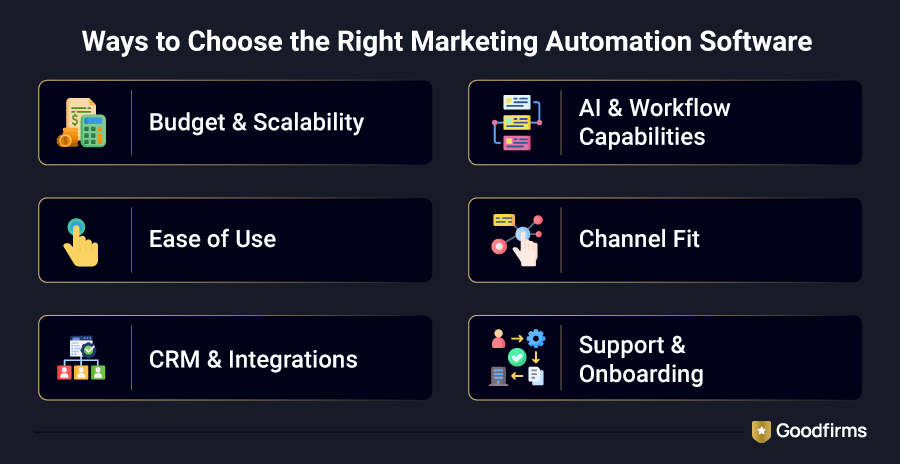
Choosing the right marketing automation software for your startup comes down to four things: team size, primary channel, budget, and how technical your team is, not which platform ranks highest on review sites.
Budget and Scaling
Look past the monthly price and check what you'd pay once your list doubles. Klaviyo, for example, starts at $20 a month but climbs into the hundreds once you hit 20,000 contacts. Always ask what the cost looks like at twice your current size before you sign up.
Ease of Use
A good platform should let someone on your team build a working automation in their first hour, with no help needed. MailerLite and Brevo are built for that kind of simplicity. If you need a support call just to send your first email, that's worth noticing early.
CRM and Data Integration
Make a quick list of the tools this platform needs to connect with your CRM, Stripe, Slack, or any analytics tool. HubSpot and EngageBay make this easy since CRM and marketing already live in one place. Some "integrations" are really just one-way exports that still need manual work.
AI and Workflow Capabilities
A simple way to test this: does the platform treat two different customers differently on its own, or does it send the same email to everyone? Tools like ActiveCampaign and Klaviyo genuinely adapt to real customer behavior. If a platform can't do that, its "AI" label is mostly just marketing.
Channel Fit
Think about where your customers actually are. An online store needs a tool built for purchase behavior, like Klaviyo or Omnisend, while a SaaS startup needs one built around product usage, like Customer.io or Encharge. Picking the wrong fit often means paying for features you'll never use.
Support and Onboarding
Before signing up, check what kind of support you'll actually get if something breaks. Many free or entry-level plans offer only email support, with slow response times. If your team can't afford downtime, this matters just as much as any feature.
Every startup will land on a different answer here, and that's completely fine; what works for a two-person bootstrapped team won't always work for one that's already raised funding.
FAQs - Marketing Automation Software
Which is the best AI marketing automation platform for startups?
There's no single best marketing automation software for startups; it depends on your stage and channel. HubSpot fits startups wanting CRM and marketing in one system, Klaviyo fits e-commerce, and Customer.io fits SaaS teams tracking usage. Match the tool to your team size, not brand recognition.
Can I use AI marketing automation without a marketing team or experience?
Yes, tools like MailerLite and Brevo are built for this exact situation. They handle email marketing automation for startups with drag-and-drop builders and no setup experience needed. More advanced platforms assume some technical comfort, so start simple and upgrade later.
How much does AI marketing automation actually cost for a seed-stage startup?
Most seed-stage startups offer free or low-cost plans, often under $100/month. Free tiers from HubSpot, Brevo, or MailerLite cover early testing, and marketing automation software pricing scales up as your contact list grows—budget for the cost at double your current size, not just today's price.
What features should I look for in marketing automation software?
Look for lead scoring, behavioral segmentation, CRM integration, and multi-channel support first. These are the core pieces behind choosing marketing automation software for startups that actually gets used daily. Skip extras you won't touch in your first year.
How do I prove marketing ROI to investors with AI automation platforms?
Platforms like HubSpot and ActiveCampaign track CAC, conversion rates, and channel performance automatically as campaigns run. That data becomes ready-made evidence for investors without extra manual reporting. Choosing startup customer acquisition tools that surface these numbers by default saves the scramble before your next board meeting.
Final Words
The right marketing automation software for startups depends on where you actually are, not which one has the longest feature list. If you're still validating messaging, you need something closer to MailerLite or Brevo. If you're a funded SaaS team automating on product usage, you need Customer.io or Encharge instead, and an ecommerce brand's answer looks nothing like either.
What ties all ten tools together is the same underlying problem: too much manual follow-up and not enough hours to do it consistently. Matching the platform to your team size, primary channel, and budget, not just picking the most recognized name, is what decides whether this becomes a tool you actually use, or a line item nobody logs into by month three.
Still weighing CRM vs. a marketing-first tool? Browse customer relationship management software and AI automation tools options on Goodfirms before you commit to a plan.