Key takeaways
- Lead Capture & Chatbots: AnyBiz and Leadfeeder qualify and route high-intent prospects automatically, cutting cost per lead from $75 to $0.40.
- Outreach & Prospecting: LeadIQ, LeadSquared, and Pipedrive replace manual research with AI-driven automation, boosting lead conversion rates by up to 30%.
- Nurturing & Automation: ActiveCampaign and Zoho CRM run adaptive, behavior-based nurture sequences that increase qualified leads by 451% and drive 47% larger purchases.
- CRM & Pipeline Management: Salesforce Einstein AI and Freshsales use predictive scoring on real CRM data to boost sales productivity by 20% and focus reps on deals that actually close.
- Customer Retention: HubSpot Service Hub, ActiveCampaign, and Zoho CRM detect churn signals early and trigger automated re-engagement, driving 22% higher retention rates.
Customer acquisition cost is rising faster than most marketing budgets. Teams using AI automation tools across customer acquisition and retention are spending less per lead and closing more.
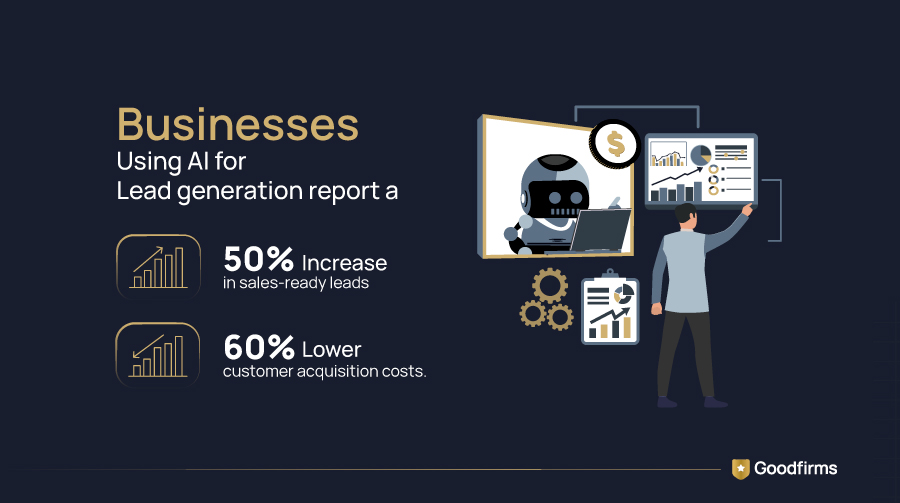 Source: 2026 Lead Generation Statistics
These numbers show that the role of AI tools is growing in customer acquisition and retention. But with thousands of platforms claiming to reduce CAC (Customer Acquisition Cost), the real challenge is knowing which tools are worth the budget, what they actually do, and how verified users rate them.
This guide can make that easier for you by segmenting AI tools across five areas that matter most in 2026-27: lead capture and chatbots, outreaching and prospecting, nurturing & automation, CRM pipeline management, and customer retention. Each AI tool recommended in this Five-Stage AI Acquisition Stack here links to its users’ reviews verified by Goodfirms, so you can read what real users have to say before making purchasing decisions.
Not sure which AI tool fits your customer acquisition stack? Go through this list of the best Artificial Intelligence software & tools with reviews from real users.
Before we move towards the Five Stage AI Acquisition Stack, let’s try to understand what the real data actually says about AI's measurable impact on acquisition costs, lead quality, and sales productivity. The numbers below come from Gartner, IBM, Salesforce, WifiTalents, and Goodfirms’ research, and they make a compelling case for why the shift toward AI-driven acquisition is accelerating, not slowing down.
AI in Customer Acquisition: Key Statistics and Data Points
- AI slashes lead research time from 15–20 minutes to just 30 seconds, cutting cost per lead from $75 to $0.40.
- Gartner predicts AI will autonomously resolve 80% of common customer service issues without human intervention by 2029.
- IBM projects AI-powered customer service will deliver a 30% reduction in operational costs for adopting businesses.
- Companies using AI-driven marketing automation see a 451% increase in qualified leads entering their pipeline.
- AI-nurtured leads make purchases 47% larger than leads that received no nurturing at all.
- Sales teams using AI are 1.3x more likely to prioritize leads effectively, with predictive scoring boosting conversions by 30%.
- High-performing sales teams are 2.8x more likely to use AI than underperformers.
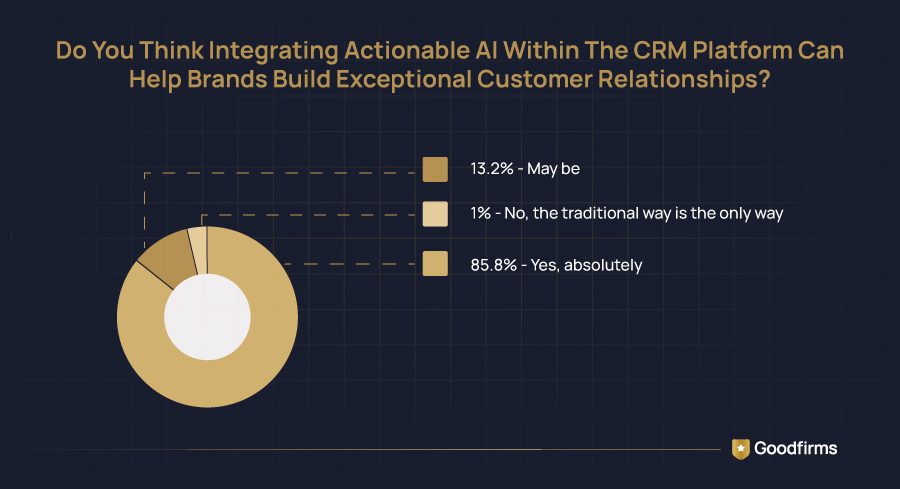
- 85.8% of CRM professionals strongly agree that AI integration helps brands build exceptional customer relationships.
- AI-based lead prioritization leads to a 20% increase in sales productivity across teams.
- Human-centric AI adopters experience 33% higher acquisition rates, 22% better retention, and 49% more cross-sell revenue.
Each statistic above maps to a specific funnel stage where AI is already doing measurable work — cutting research time at the top, improving lead quality in the middle, and reducing churn at the bottom. The Five-Stage AI Acquisition Stack is built around exactly that logic: a connected sequence of tools, each owning a distinct job, structured the way the best-performing acquisition teams are actually spending their AI budgets.
Each of the ten tools covered across these five layers serves a distinct acquisition function. Before we go through the in-depth information about each AI tool in the five-stage AI acquisition stack, let's have a look at the comparison table below that brings them together so you can compare use cases, pricing, and free access options at a glance.
Comparing the Best AI Tools for Customer Acquisition in 2026-2027
This comparison table helps you identify where your current stack has gaps or where you are paying for capabilities you already have elsewhere.
|
Tool |
Use Case |
Best For |
Starting Price |
Free Version / Free Trial |
|---|---|---|---|---|
|
AnyBiz |
AI lead capture + meeting booking |
Teams wanting fully automated 24/7 prospecting |
$497/month |
❌ |
|
Leadfeeder |
Website visitor identification + intent scoring |
B2B teams with meaningful inbound traffic |
$116/month |
✅ |
|
LeadIQ |
LinkedIn prospecting + CRM enrichment |
SDR teams on Salesforce or HubSpot |
$15/month |
✅ |
|
LeadSquared |
Multi-channel lead capture + pipeline management |
High lead volume teams across mixed channels |
$15/month |
❌ |
|
Pipedrive |
ML sales assistant + deal pipeline automation |
High-volume deal teams without RevOps |
$14/month |
✅ |
|
ActiveCampaign |
AI email automation + behavioral nurturing + retention |
B2B and B2C teams running multi-step sequences |
$15/month |
✅ |
|
Zoho CRM |
AI nurturing + CRM + post-sale retention |
SMB all-in-one acquisition and retention |
$15/month |
✅ |
|
Salesforce Einstein |
AI scoring + Agentforce automation |
Existing Salesforce enterprise teams |
$25/month |
✅ |
|
Freshsales |
Freddy AI scoring + pipeline management |
SMB sales teams wanting fast implementation |
$9/month |
✅ |
|
HubSpot Service Hub |
AI helpdesk + churn prevention + retention |
Teams managing post-sale customer lifecycle |
$15/month |
✅ |
The comparison table above breaks down ten leading AI tools across key parameters — use case, ideal user, pricing, and trial availability — giving you a quick snapshot of where each tool fits within your acquisition workflow. The sections that follow organize these tools into a cohesive five-stage AI acquisition stack, so you can see not just what each tool does, but exactly where it belongs in your customer acquisition journey.
AI Tools for Customer Acquisition: Five-Stage AI Acquisition Stack
The five-stage AI acquisition stack below guides businesses from initial awareness through conversion, leveraging purpose-built AI tools for each phase of the customer journey. By aligning the right AI solutions to each acquisition stage — from discovery and engagement to nurturing and retention — companies can build a more efficient, data-driven pipeline that reduces manual effort and improves conversion rates.
Stage 1: AI Tools for Lead Capture and Chatbots
AI for lead capture & chatbots qualify prospects in real time — asking the right questions, scoring responses, and routing high-intent visitors to the right rep before a single human gets involved.
As per AI in Lead Enrichment: Industry Insights: AI tools reduce lead research time from 15–20 minutes to 30 seconds, cutting the cost per lead from $75 to $0.40
Gartner Predicts Agentic AI Will Autonomously Resolve 80% of Common Customer Service Issues Without Human Intervention by 2029, and, according to IBM’s guide to AI customer service chatbots, this advancement is expected to lead to a 30% reduction in businesses’ operational costs.
Below are the two AI tools that cover this layer most effectively with verified Goodfirms reviews.
AnyBiz
AnyBiz runs AI sales agents that engage prospects 24/7 across email and LinkedIn without human input. Its agents research each target, craft personalized messages based on recent online activity, and book meetings automatically. The platform analyses over 10,000 data points per hour to continuously refine outreach. Goodfirms reviewers report 18+ booked appointments per month and consistently highlight the domain warming feature as a meaningful deliverability advantage.
|
Subscription Cost : Starts from $497/Month |
Free Version: ❌ Free Trial: ❌ |
nyBiz's AI sales agents are really amazing; they handle every aspect of our outreach efforts. In a month, we received 18 booked appointments. This is impressive. - Eliakim Shmuelovitz, Marketing Manager at Xpansion.
Read More Verified Users’ Reviews About AnyBiz on Goodfirms
Leadfeeder
Leadfeeder takes a different approach — it identifies the companies visiting your website anonymously, scores them by intent, and routes the highest-value visitors into your CRM before they fill out a form. For B2B teams with meaningful inbound traffic, it surfaces warm leads that outbound-only tools cannot see. Goodfirms reviewers highlight its ability to visually track which contacts are visiting and sort leads by quality, with direct integration into Zoho and HubSpot.
|
Subscription Cost : Starts from $116/Month |
Free Version: ✅ |
enerating leads is so crucial, without which growing and expansion aren’t really possible. My company has been using this Lead Generation Software, for the past two years, and has been getting spectacular results since then.- Richard Lubicky, Founder/CEO at RealPeopleSearch
Read More Verified Users’ Reviews About Leadfeeder on Goodfirms
Stage 2: AI Tools for Outreach and Prospecting
Most sales teams lose hours every week to manual research, writing first lines, and timing follow-ups. AI for outreach and prospecting replaces that work with signal-driven automation that scales without adding headcount.
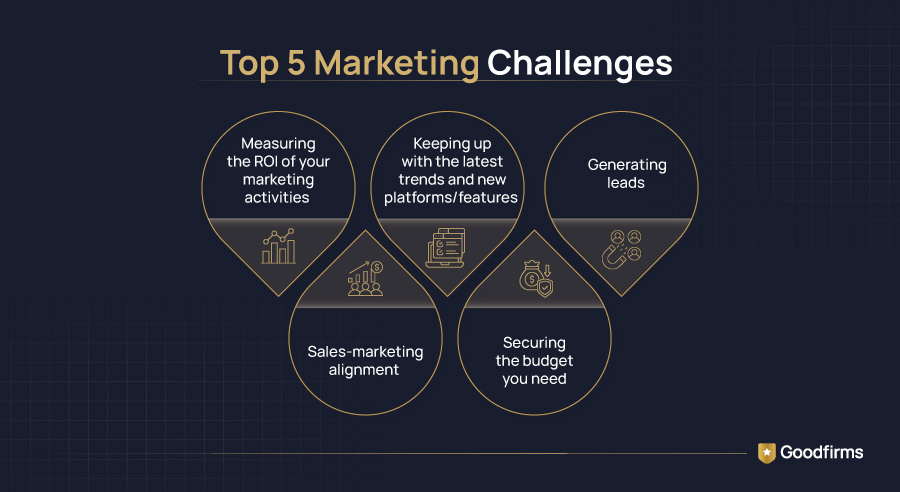
As per HubSpot's State of Marketing report 2026, generating leads is one of the top 5 marketing challenges in 2026. The gap between quantity and quality of leads generated is where AI outreach tools earn their budget.
Sales teams using AI are 1.3 times more likely to prioritize leads effectively, and predictive lead scoring increases conversion rates by 30%, according to WifiTalents' 2026 AI in sales data report. The AI tools listed below have enough potential to overcome the challenge of outreaching and prospecting leads and, at the same time, achieve desired sales numbers.
Below are the three Goodfirms-curated tools that dominate this layer.
LeadIQ
LeadIQ streamlines LinkedIn-based prospecting for CRM-first B2B workflows. Reps browse LinkedIn, click the LeadIQ extension, and contacts sync directly into Salesforce or HubSpot with enriched data. Its AI message writer drafts personalized outreach using recent activity, job changes, and company news — removing the manual research that slows most outbound teams. Goodfirms reviewers describe it as one of the most practical AI lead generation software options for making prospecting faster from web and social sources.
|
Subscription Cost : Starts from $15/Month |
Free Version: ✅ |
LeadIQ is widely recognized for its ability to streamline the lead generation process, making it easier for sales teams to find and capture leads directly from the web and social media platforms.” - Lishi He, Founder & CEO at Fork.ai
Read More Verified Users’ Reviews About LeadIQ on Goodfirms
LeadSquared
LeadSquared handles multi-channel lead capture across web, phone, chat, and field sales in a single platform. Its AI prioritizes leads intelligently, reduces lead leakage, and attributes ROI accurately to specific campaigns and sources. For teams figuring out how to use AI for B2B customer acquisition across mixed channels simultaneously, LeadSquared handles the full capture-to-pipeline workflow without requiring separate tools for each source.
|
Subscription Cost : Starts from $15/Month |
Free Version: ❌ Free Trial: ❌ |
We have been using their CRM for lead capturing and nurturing. So far, we have converted a good number of leads from cold to hot leads. - Commitbiz, Founder and CEO at Commitbiz LLC
Read More Verified Users’ Reviews About LeadSquared on Goodfirms.
Pipedrive
Pipedrive uses a machine learning sales assistant to surface next-best-action recommendations for each active deal. Its visual pipeline interface, AI-powered activity reminders, and email follow-up automation make it the most practical option for sales teams managing high deal volumes without a dedicated RevOps function. Goodfirms reviewers specifically highlight its drag-and-drop simplicity and the accuracy of its ML-driven sales assistant.
|
Subscription Cost: Starts from $14/Month |
Free Version: ❌ Free Trial: ✅ |
We, the Electrician Apprentice HQ, have been using Pipedrive for a few years now and probably utilize it several times per week. One of the main reasons we like it is that it utilizes a machine learning sales assistant, which is highly accurate. Thomas Hawkins, CEO at Electrician Apprentice HQ
Read More Verified Users’ Reviews About Pipedrive on Goodfirms.
Stage 3: AI for Nurturing and Automation
Getting a lead into the pipeline is one problem. Keeping them warm until they are ready to buy is another. AI for nurturing and automation handles the second problem — tracking consumer behavior in real time and engaging leads automatically until they are ready to talk.
As per the Salesforce Report, companies using marketing automation to nurture prospects see a 451% increase in qualified leads. Those nurtured leads, in turn, make purchases 47% larger than their non-nurtured counterparts.
Below are the two Goodfirms-curated tools that dominate this layer.
ActiveCampaign
ActiveCampaign combines AI-integrated email automation, CRM, and behavioral segmentation in one platform. Its machine learning engine determines optimal send times per contact, predicts which leads are most likely to convert, and adapts multi-step nurture sequences based on engagement history. For teams looking to use AI for B2B customer acquisition without stitching together multiple platforms, ActiveCampaign handles the full nurture workflow in one place.
|
Subscription Cost: Starts from $15/Month |
Free Version: ❌ Free Trial: ✅ |
We at Sydney Digital Agency use Active Campaign for email automation to send emails frequently about our blogs and the latest updates of our services for the last three years. It's super easy to manage complex email marketing campaigns. - Rakshit Panchal, Marketing Specialist at Sydney Digital Agency.
Read More Verified Users’ Reviews About ActiveCampaign on Goodfirms.
Zoho CRM
Zoho CRM handles prospect data, lead nurturing, and enrichment within a single platform. Its AI assistant Zia analyses patterns across the contact database, identifies the optimal moment to reach each prospect, and automates follow-up triggers based on behavior. It is one of the best CRM tools powered by AI that runs multi-step nurture sequences at scale.
|
Subscription Cost: Starts from $15/Month |
Free Version: ❌ Free Trial: ✅ |
Our company, My Enamel Pins, has been using Zoho CRM as its primary software for contact and customer relationship management since 2017. It offers great integrations with other services that easily allow us to extend the platform’s functionality. - Davin Joseph, CEO at My Enamel Pins.
Read More Verified Users’ Reviews About Zoho CRM on Goodfirms.
Stage 4: AI CRM and Pipeline Tools
Raw prospect data without scoring sends your best reps after the wrong accounts. AI CRM and pipeline tools are the mechanism that determines whether your sales team's time is spent on deals that close or deals that stall.
As per Goodfirms’ Research - Know AI CRM to Know Your Customers, 85.8% respondents agreed strongly that AI integration within the CRM can surely help brands build exceptional customer relationships.
Also, according to the WifiTalents Report 2026, AI-based lead prioritization leads to a 20% increase in sales productivity, and high-performing sales teams are 2.8 times more likely to use AI than underperformers.
The two AI tools mentioned below are known to justify this layer very well.
Salesforce Einstein AI
Salesforce Einstein AI is the right call for teams already on Salesforce. Einstein Lead Scoring trains predictive models directly on your historical CRM conversion data — no manual rules, no external pipelines. Agentforce, launched broadly in 2025, extends this to autonomous agents handling inbound qualification and follow-up without human intervention.
|
Subscription Cost: Starts from $25/Month |
Free Version: ❌ Free Trial: ✅ |
We Credityelp LLC have been using this software for a couple of years. This app assists in many analysis and decision-making processes. It plays a vital role in marketing our service to the target audience. - Jonathan Tian, Founder at Credityelp LLC .
Read More Verified Users’ Reviews About Salesforce Einstein AI on Goodfirms.
Freshsales
Freshsales brings Freddy(AI-powered lead scoring and contact enrichment agent) into a CRM built for fast-moving sales teams. Freddy guides reps toward deals with the highest close probability, flags at-risk accounts, and automates follow-up triggers based on prospect behavior.
|
Subscription Cost: Starts from $9/Month |
Free Version: ❌ Free Trial: ✅ |
We at Truepersonfinder are using Freshsales for our organization. Its AI, Freddy, guides us to close a deal that has high potential. It really saves us time and effort in closing a deal. - Madilyn Hill, CEO at Truepersonfinder
Read More Verified Users’ Reviews About Freshsales on Goodfirms
Stage 5: AI for Customer Retention
AI for customer retention monitors engagement signals, flags early churn indicators, and automates re-engagement, so your team acts before the cancellation email arrives.
As per Zendesk 2025 CX Trends Report: Human-Centric AI Drives Loyalty - CX Trendsetters experience 33% higher customer acquisition rates, 22% higher customer retention rates, and 49% higher cross-sell revenue, proving that a thoughtful approach to AI can be transformative. The businesses pulling ahead are using AI to identify at-risk customers before they churn instead of sending win-back emails after they already have.
Among the AI tools most commonly used for customer retention, three stand out: ActiveCampaign, Zoho CRM, and HubSpot Service Hub. Having already explored ActiveCampaign and Zoho CRM earlier in this guide, it's worth taking a closer look at what HubSpot Service Hub brings to the table.
HubSpot Service Hub
HubSpot Service Hub uses AI in live chat, email, and helpdesk to monitor early churn signals, declining product usage, negative support ticket sentiment, longer response-time tolerance, and triggers automated retention flows before customers drift. Its feedback tools surface pain points in real time, and every signal routes back to the same CRM used for acquisition, giving teams a complete lifecycle view without switching platforms.
|
Subscription Cost: Starts from $15/Month |
Free Version: ✅ |
Nice to get started with this tool. From the day I installed this software on my website, it increased my customers' attention. I love this so much, as it is a very promising platform. They provide satisfactory features and services that we can easily use. - Sadie Andrews
Read More Verified Users’ Reviews About HubSpot Service Hub on Goodfirms.
The information covers what each tool offers. What it does not settle is fit — and fit is the only thing that determines whether an AI tool lowers your CAC or adds to your overhead. This is where the question “how to pick the right AI tool for the customer acquisition stack” arises. Let’s have a look at the answer to this question.
How to Pick the Right AI Tool for Your Acquisition Stack
The wrong tool for the wrong problem is how AI budgets disappear without results. Marketing technology utilization sits at just 33% across businesses, per a 2024 Gartner benchmark — meaning most companies are already underusing the tools they pay for before adding new ones.
Three questions that narrow the decision before any trial:
What is the primary acquisition problem — too few leads, too many unqualified ones, or too slow a journey from lead to close? Each answer points to a different section of this guide. Capture tools fix the first problem. Scoring tools fix the second. Nurture and CRM tools fix the third.
What does the existing stack look like? Teams already on Salesforce get more value from Einstein than from a standalone scoring tool. Teams with no CRM at all get more value from Zoho or HubSpot before adding any enrichment layer.
What is the retention rate? A business losing 10% of customers monthly needs to close that gap with HubSpot Service Hub or ActiveCampaign's retention flows before increasing outreach volume — otherwise, every new customer acquired simply replaces one lost.
Every tool in this guide has a dedicated listing on Goodfirms with verified user reviews. If none of the ten above fit your exact situation, you can explore more options in the AI lead generation software directory, CRM tools category, and marketing automation listings, which cover hundreds of additional verified options across every budget and team size.
Picking the right tool is step one. Getting it to actually know how to lower your customer acquisition cost with AI is step two — and that requires knowing proven strategies for using these AI tools to spend less on each customer you acquire.
How to Lower Your Customer Acquisition Cost With AI
Most rising CAC problems are not team problems. They are targeting problems, timing problems, and data quality problems — and AI addresses all three more efficiently than any manual process can. The teams seeing the largest CAC reductions are not spending more. They are spending more precisely, on the right accounts, at the right moment, with the right message.
Five specific applications move the needle most.
1. Target On Intent, Not Demographics
Traditional broad-based targeting charges you for exposure to people who will never buy. AI-powered segmentation identifies which accounts are already showing purchase intent — through website behavior, content engagement, and firmographic signals — and concentrates spend on those accounts before a single rep gets involved. Tools like Leadfeeder and LeadIQ both operate on this principle, surfacing warm accounts rather than waiting for a form submission that may never come.
2. Replace Manual Research With Signal-Driven Personalization
The practical difference between outreach that gets replies and outreach that gets deleted is specificity. Referencing a prospect's recent funding round, a leadership change, or a product launch they announced last week lands differently than a template with a first name inserted. AI tools pull those signals automatically and build them into outreach at scale — turning what used to take a rep twenty minutes per contact into something that happens in seconds across thousands of prospects simultaneously.
3. Score Leads Before Your Reps Call Them
Every hour a rep spends on a low-probability account is an hour not spent closing a high-probability one. That misallocation compounds quietly into a CAC problem that looks like a sales performance problem. AI lead scoring in HubSpot, Salesforce Einstein, and Freshsales ranks accounts against your own historical conversion data — so your team's time goes to the deals most likely to close, not the ones that look promising on the surface.
4. Fix Retention Before Scaling Acquisition
The fastest way to lower net CAC is to stop losing the customers already won. Every churned customer means the acquisition spend that landed them produced no lasting return, and the cost of replacing them gets added to the next month's CAC calculation. AI retention tools like HubSpot Service Hub catch those at-risk accounts before they cancel, reducing the silent churn that inflates acquisition cost without anyone noticing until the quarterly numbers come in.
5. One Thing To Get Right Before Anything Else
AI tools running on stale, incomplete, or inconsistent data produce confident-sounding but wrong outputs — and wrong outputs cost more than no outputs at all. Before adding any AI tool to the acquisition stack, the underlying contact data needs to be clean and current — stale records fed into any AI scoring model produce confident-sounding predictions that send reps after accounts that closed six months ago. The teams that skip this step buy expensive tools that amplify the same targeting mistakes they were already making manually.
Cutting CAC with AI is one thing — knowing what sits behind those decisions is another. Before you buy, compare, or migrate anything, these questions are worth settling.
Frequently Asked Questions Relating to AI Tools for Customer Acquisition
From first-time buyers to teams switching platforms, these are the questions that shape most AI acquisition tool decisions in 2026 and beyond.
Does AI lead generation software work for niche B2B markets?
Yes. Tools like LeadIQ and LeadSquared filter by firmographics, job role, and intent signals — making them more precise in niche markets than broad-based paid campaigns.
How long does it take AI tools to show measurable CAC improvement?
Most teams see meaningful data within 60 to 90 days. Scoring models need enough conversion history to train on before their outputs become reliable.
Can AI-powered marketing automation tools replace a sales development rep?
They replace the research and sequencing tasks — not relationship judgment. AnyBiz handles 24/7 outreach, but complex deal negotiations still need a human in the loop.
What data does an AI CRM tool need to produce accurate lead scores?
It needs a minimum of 200 to 500 historical closed deals with consistent field completion — company size, source, and deal stage data being the most critical inputs.
Is there a free AI CRM tool for small business teams just starting out?
Yes, Zoho CRM and Freshsales both provide free trials before any paid commitment is required.
How does AI handle multi-channel B2B customer acquisition without duplicating outreach?
LeadSquared centralizes web, phone, chat, and field inputs into one pipeline. Deduplication logic flags overlapping contacts before any outreach sequence fires across channels.
Do AI-powered marketing automation tools require technical setup expertise?
ActiveCampaign and HubSpot are built for non-technical teams. Salesforce Einstein requires more configuration but offers enterprise-grade depth in return for that investment.
What metrics confirm that AI lead generation software is performing as expected?
Track cost per qualified lead, average sales cycle length, and lead-to-close rate monthly. All three should move together — an improvement in one but not the others signals a gap elsewhere.
Conclusion: Selecting the Best AI Tools for Customer Acquisition Starts With Identifying the Gaps
Rising CAC is rarely a budget problem — it is a precision problem. The teams closing more at lower cost are not using more tools; they are using the right ones at the right stage. Whether that means surfacing intent with Leadfeeder, scoring pipeline with HubSpot or Freshsales, automating nurture with ActiveCampaign, or catching churn with HubSpot Service Hub, which also ranks among the best customer service software for post-sale lifecycle management, every tool here has a verified track record on Goodfirms. Pick the stage costing you the most, start there, and let clean data drive what comes next.