"He that resolves upon any great and good end, has, by that very resolution, scaled the chief barrier to it" - F. Tryon Edwards, writer & educator.
Modern customers expect higher than ever, which undoubtedly raises the bar of service desk operations. Almost every employee and customer desires instant resolution to their IT issues and concerns. Use of AI in IT services and support isn’t new. But advancements in ML, AI, Gen AI, etc., have rapidly fueled the deployment of these technologies within the service desk processes in recent years. This trend is puschin more businesses to invest in AI-powered service desk software to slash resolution time by over 50%, ensuring better agility, efficiency, and responsiveness from their service desk operations.
Companies that fail to invest in AI will fall behind. AI-powered service desk tools come with features and specifications that can help businesses lower their resolution time. However, implementation alone won’t help achieve the desired or anticipated results. Rather, businesses need to have certain practices and measures in place through which the full potential of the AI service desk systems can be unlocked while simultaneously lowering the resolution times.
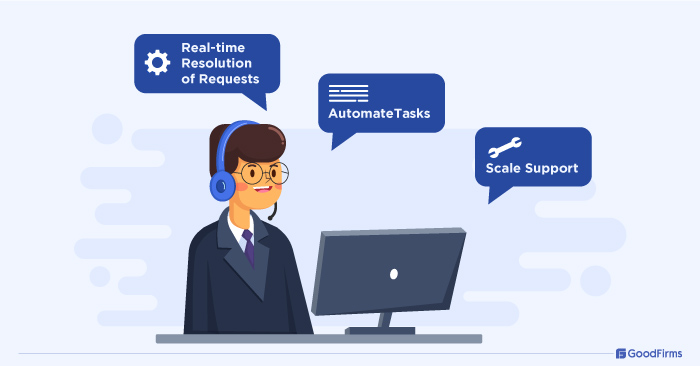
This blog highlights the key practices that can slash the resolution time by over 50% with an AI-backed service desk software. Besides the key practices, a discussion on the importance of AI service desk, difference between traditional and AI service desk software, consideration factors to select an AI service desk solution, and future AI service desk software trends has also been done to help you make the right decision.
Introduction to AI-backed Service Desk
AI-backed service desk is an evolution of the traditional service desk processes in which emerging technologies like artificial intelligence, automation, Generative AI, deep learning, machine learning, etc., are leveraged to enhance the effectiveness of IT service management. AI-powered service desk software systems offer enhanced human-like interactions, context management, sophistication, efficiency, and data-driven insights that are best to efficiently manage service requests, incidents, frequently asked questions, and other IT-based tickets. Not only this, but AI service desk systems can also help service desk agents quickly generate tickets with faster communication and turnaround times.
AI-backed Service Desk vs Traditional Service Desk
For a long time, traditional service desk solutions have effectively met the IT support needs of organizations of all sizes and types. However, over time, the change in dynamic user preferences, the nature of the businesses, and employee requirements have negatively impacted the performance and results of these outdated systems. Additionally, these traditional service desk systems are also not reliable enough to handle increased ticket load, complex repetitive tasks, and a huge number of manual processes. As a result, these are slowly being replaced with AI service desk systems that come with unparalleled accuracy, transparency, and efficiency. AI-backed service desk systems also offer lower resolution time, allowing IT support teams to resolve issues instantly.
Comparison between traditional and AI-backed service desk systems;
|
AI-backed Service Desk Systems |
Traditional Service Desk Systems |
|
Predictive and proactive |
Reactive |
|
Optimized resolution time |
Comparatively higher resolution time |
|
Quick and automated algorithm-based ticket creation |
Slower ticket creation process that requires somewhat human intervention |
|
Robust ticket handling capacities |
Poor ticket handling abilities |
|
High setup costs but cost-effective |
Low setup costs but slow |
|
Intelligent resource allocation |
Manually allocate resources |
|
Highly automated for complex task handling |
Minimal automation for basic service desk task handling |
|
Training is required for unlocking maximum productivity |
Not proper training sessions are needed due to ease of use |
|
Advanced AI chatbots that can understand context |
Typical chatbots that only redirect to relevant documentation |
|
Personalized service desk support |
Scripted replies with no personalization |
|
Can learn from existing service desk data |
Cannot learn from data |
|
Omnichannel automation and management |
Limited abilities to integrate omnichannel experience |
|
Enhanced security with detailed audit logs, data encryption, and access controls. |
Basic security features for login, registration, and data encryption |
Overall AI backed service desk software tools are the optimal choice for businesses looking to slash their resolution times, improve employee experience, and provide personalized support solutions to the employees. But, AI backed service desk solutions may be proved costly as employees need expensive training to fully acquire the best results.
Why is an AI-backed Service Desk So Critical Today?
In this fast-paced era, quickly providing answers to user queries is among the best customer service practices. Not promptly resolving the IT tickets and queries can negatively impact the business performance and user experience. According to a recent research 45% of employees feel that technological limitations, resource unavailability, slow resolution rate, high ticket volume, system overload, complex task handling, etc., are impacting their service desk operations. Additionally, work from home and hybrid working environments are also putting immense pressure on the service desk teams.
Another critical factor behind employee, user and customer dissatisfaction is high response and resolution time. Around 82% business leaders stated their Mean Time to Resolution is over an hour. While users desire resolution to their queries in comparatively less time, this high-resolution time could significantly cost the business in terms of efficiency, scalability, and productivity.
All these service desk-related concerns can be easily resolved by replacing the existing service desk systems with advanced AI-based service desk software. Additionally, around 92% of businesses are already leveraging AI to improve service response and resolution times. This number will grow further as the number of IoT devices reaches 18.8 billion by the end of 2024. By implementing AI service desk solutions, businesses can achieve better device connectivity, enhanced speed, optimized ticket handling costs, improved user experience, reduced errors, and greater flexibility while also promptly resolving the IT tickets.
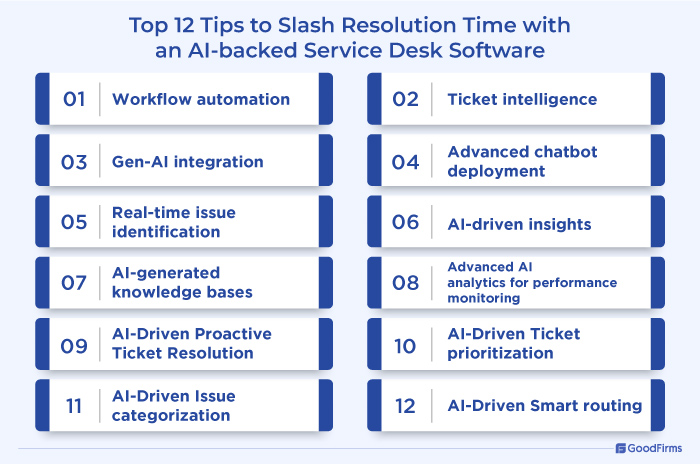
Top 12 Tips to Slash Resolution Time with an AI-backed Service Desk Software
Slashing resolution time with an AI-backed service desk software is relatively very easy and sophisticated. Use and implement the below mentioned AI-based techniques and methods to actively improve your service desk resolution time.
#1 Workflow Automation
This is one of the best advantages of AI-backed service desk software, which significantly reduces resolution time. Through workflow automation, service desk teams can automatically perform functions like alerts, incident summarization, root cause identification, ticket routing, etc., that could lead to a 50% reduction in MTTR (mean time to repair). Traditional service desk systems could only automate a few tasks, but AI service desk tools can even perform complex workflow automation tasks such as automated incident categorization, intelligent agent assigning, real-time anomaly detection, automatic ticket creation, etc., leading to rapid task execution, reduced errors, and optimized costs, all while nearly halving the resolution time.
AI can also help businesses design highly efficient workflow automation and implement conversation automation to usher in a new era of customer service and IT services desk. AI-backed workflow automation is widely being implemented by the IT support teams to improve operational efficiency, schedule responses to general queries, and enhance the focus of employees on high-priority service desk-based tasks.
#2 Ticket intelligence
Ticket intelligence refers to the use of AI, ML and other relevant technologies to quickly classify and process IT tickets. AI-based service desk software systems also offer ticket intelligence features to create, classify, prioritize, and route tickets to the appropriate teams. These smart ticketing systems eliminate human intervention when managing tickets from multiple channels. Fast and quick responses with improved customer experiences are the benefits of cognitive-based ticket management. When a ticket cannot be automatically resolved or needs to be escalated, then AI-backed services desk tools can redirect them to the right agent or team.
These systems may also support keyword based ticket categorization, automated ticket triaging, canned responses, ticket context analysis, resolution recommendations, customer sentiment analysis, ticket summary generation, etc., that help further slash the ticket resolution time. Best AI ticketing software systems can also automatically tag the IT service desk tickets to reduce human error and improve service quality.
#3 Gen-AI integration
Another notable method to slash the service desk resolution time by half is to leverage Gen-AI integration. According to the 2024 Technology Key Issues Study, approximately 88% of businesses are evaluating Gen AI for service/help desk. Gen AI uses advanced natural language understanding and processing abilities that can generate real time responses, summarize conversations, create new knowledge base articles, provide multilingual support, etc., to quickly understand and resolve the services desk queries in a timely manner while ensuring optimum experiences.
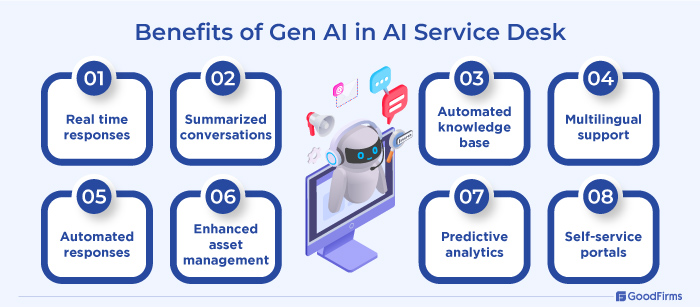
With Gen AI integration, businesses can also automate the responses for FAQs, enhance asset management, and provide personalized support without human involvement. Additionally, Gen AI also helps with quick content and graphics generation that can be used to promptly serve the answer to the IT service desk queries. Besides above mentioned uses and benefits, Gen AI integration is a versatile choice for service desk teams looking to revolutionize their support by centralizing help, automating employee requests, large scale data analysis, and providing highly relevant insights to assist with enhanced decision making abilities.
#4 Advanced chatbot deployment
At present, chatbots dominate customer service, IT service management, help desk, service desk and various other functions to automatically answer support queries. These have become very frequent in IT and customer service. However, they cannot keep up with the growing demands and challenges and, hence, should be replaced with advanced AI-based chatbots. In fact, one-third of Americans use an AI chatbot to get answers to their queries. Advanced chatbots not only serve answers to the tickets but can also understand ticket context, learn from past interactions and data, and can even be assigned to handle only specific types of requests.
Additionally, advanced chatbots offers continuous 24*7 service desk availability, automated query resolution, personalized responses, etc., Deploying an advanced chatbot would significantly reduce the burden on human agents while also ensuring instant responses to the incoming tickets and queries.
#5 Real-time issue identification
Real-time issue identification helps service desk teams instantly identify and resolve IT tickets as soon as they occur. This not only reduces the resolution time but also prevents a small issue from becoming a huge escalation. AI services desk software having real-time issue identification capabilities comes with features like automated alerts, proactive monitoring, root-cause analysis, incident grouping, real-time notifications, etc., that eliminate effort wastage and halve the resolution and response times. Rapid issue detection, proactive resolution, reduced ticket volume, and longer system uptime, ensuring maximum customer satisfaction and success rate of the service desk teams are some of the major benefits of AI-powered omnichannel support.
#6 AI-driven insights
Business insights are critical to improve current and future business operations, bring stability, reduce costs, lower agents’ time to resolution, identify risks, derive data patterns, and improve agility. Cognitive insights from AI service desk tools can easily and quickly collect, process, analyze and visualize the data to generate reliable insights that human agents may overlook. Through these AI-powered insights, agents can quickly identify issues that are delaying ticket resolutions, enhance customer experience, reduce errors, improve workflow and minimize costs.
Not only this, AI-driven insights are also important for service desk teams in determining hidden patterns and trends to forecast future trends, generate actionable summaries of trends, automate suggestions, analyze customer sentiments, etc., ensuring enhanced service desk performance and efficiency and optimized reaction time.
#7 AI-generated knowledge bases
In the last few years, knowledge bases for self-service have been incorporated in the IT service and support functions. Around 38% Gen Z and millennials prefer self service for resolving their issues. AI service desk software can now incorporate AI-guided incident solutions and knowledge base articles in real-time while the incidents are happening to optimize resolution times further. The AI tools can analyze past ticket details, FAQs, documentation, etc., to draft the self-service knowledge articles for quick troubleshooting. Through this, service desk agents can quickly create new articles or modify existing ones if no existing content relevant to queries is found, ensuring timely ticket resolution. Not only this, but AI can also appropriately understand the intent behind user search queries, enabling better search accuracy for acquiring information from the existing knowledge bases. Self service knowledge bases are also a great choice for service desk teams looking to provide immediate answers to simple IT queries without any waiting lines and agent requirements.
#8 Advanced AI analytics for performance monitoring
AI-based service desk systems can also offer advanced AI analytics that are beneficial for businesses in performance monitoring. Modern AI service desk solutions provide real time monitoring and tracking into the resolution time, ticket volumes, response time, agent productivity, etc., that enable service desk managers to identify high-performing agents and replicate their processes across the entire team. Moreover, these powerful tools can generate incident summaries that can bring a broader picture into the resolution methodology, time taken, and action taken. This can enhance accountability, trust, and transparency.
Through such assistance from artificial intelligence, they can make relevant decisions to ensure optimal ITSM health and take suitable measures to improve, whenever any issue is found.
#9 AI-Driven Proactive Ticket Resolution
Earlier, IT ticket resolution used to be reactive. Agents were only able to resolve an issue after it arises. But now, service desk systems come with robust features and functionalities to proactively detect risks, and resolve IT issues and tickets, even before the problems are noticed, all because of the AI capabilities. In fact, proactive ticket resolution is among the top 5 futuristic trends to transform service desk operations. AI service desk tools can analyze real time data, IT devices behavior, usage patterns, etc., to pinpoint potential issues, patterns, and trends. Service desk, help desk or other support teams can use these patterns and trends to detect risks, take required measures to eliminate them, and scale IT Service Management.
AI can also monitor customer behavior and flag potential issues if it deviates from normal usage patterns, ensuring personalized customer interactions which are crucial for quick ticket resolution. Apart from this, AI can also proactively handle routine updates, patches, and system checks without disrupting users, ensuring reduction in overall workload on the service desk.
#10 AI-Driven Ticket prioritization
Customer service does not cost, it pays, says an expert. This is absolutely true in service desk processes. Not delivering service by prioritizing is like losing a customer or work order. Traditional methods of ticket handling often rely on manual prioritization, where agents assess the urgency of each ticket based on customer inputs or their understanding of the issue. This approach is not only time-consuming but can also lead to inconsistencies, where less critical tickets are addressed before urgent ones. Interestingly, AI-backed service desk software can now analyze various factors, such as historical data, customer profiles, issue complexity, etc., to prioritize tickets more effectively than human agents, ensuring that the most urgent and impactful tickets are addressed first.
AI-backed systems can also assess the severity of the issue based on past occurrences, potential business impact, customer history, complexity of the issue, and the availability of resources. Through this, service desk teams can easily ensure that resources are allocated efficiently, and agents can quickly resolve the issues with high severity.
#11 AI-Driven Issue categorization
Another leading method to hugely optimize the resolution time is leveraging AI for automated issue categorization. AI algorithms can automatically classify and organize tickets based on their content, customer sentiments, tone, etc., which is not possible in traditional service desk systems. Not only this, but AI can also categorize the multi-faceted issues into multiple categories which helps reduce the back-and-forth between departments and allows for faster collaborative resolution. By efficiently categorizing the tickets, AI can easily streamline the entire service desk workflows for improved response times.
#12 AI-Driven Smart routing
Unlike traditional manual routing, where tickets are often assigned based on simple parameters like the availability of resources, AI-backed smart routing uses advanced AI algorithms to match tickets with the best possible agent. Smart routing includes skill-based routing, qualification routing, omnichannel routing, prioritization routing, etc. It is based on a combination of factors, including agent specialization, past performance, ticket priority, etc. By redirecting the ticket to the most suitable agents, service desk teams can eliminate unnecessary escalations and transfer for timely resolution.
In addition, AI can also automatically escalate the high-priority tickets that affect critical business operations to senior agents, preventing the tickets from not stucking in the general queue. AI-based smart routing is highly useful for businesses looking to reduce the escalations, prevent bottlenecks, and improve the overall resolution process.
Through these techniques and practices, the service desk's resolution time can be slashed up to 50%, which means quick resolution of IT issues and enhanced employee experience.
Key Considerations for Implementing AI-backed Service Desk Software
Whenever a business opts for an AI-based service desk software, considerations of certain factors help select a reliable one that can efficiently meet organizational needs. Some of these factors that should be carefully considered by the service desk teams are as follows;
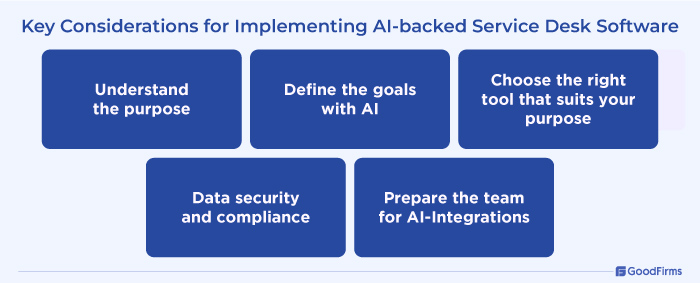
Understand the purpose
Understanding the primary purpose is the most critical requirement in implementing an AI-backed software. Businesses should have a clear understanding of the areas and problems that need to be addressed through AI-backed service desk software. It should be able to perform advanced functions and roles other than automating the service desk tasks or augmenting human agents. It should also be able to streamline complex workflows, reduce the resolution time, enhance the level of IT support, etc., without impacting the ongoing operations of the service desk support.
Define the goals with AI
Well-defined goals and vision are vital to ensure the anticipated success and results. The goals should be SMART and measurable. Businesses should also focus on establishing the key KPIs through which results can easily be observed. AI-service desk software that can deliver the anticipated customer satisfaction scores, ticket resolution speed, first response time setup, etc., will help in understanding the performance and effectiveness of the AI tools.
Choose the right tool that suits your purpose
The next step is to choose the right set of tools that are aligned with the identified purpose and goals. Careful selection of the AI-backed service desk software is necessary in order to gain anticipated results and avoid excessive implementation costs. Extra features that are not of any use can lead to more funds wasted in training and implementation, whereas lack of required features can negatively influence the expected efficiency and productivity. Also, consider scalability, customizations, ease of integration, etc., when selecting the AI tool to ensure its sustainability for a long time. Businesses that lack proper information on the features and cost of service desk tools can refer to a reliable cost and feature comparison guide to the top service desk software for making the right decision.
Data security and compliance
As AI service desk tools deal with a huge amount of customer data, security is a key consideration to ensure optimal data integrity and safety. The tool must have a wide range of security features such as 2 factor authorization, advanced access control, role-based permissions, compliances, etc., to prevent data poisoning, model theft, backdoor attacks and other types of breaches. Also, the software should also support future upgrades in the AI models and algorithms to consistently secure the service desk systems from AI powered data breaches.
Prepare the team for AI-Integrations
An ideal service desk solution with AI features can integrate with tools like data analytics, CRM, ticketing systems, social media, knowledge bases, team communication, collaboration, ERP, workflow automation, etc. However, integrations alone cannot achieve the desired results; preparing the team to effectively leverage these integrations is equally important. Businesses should provide relevant training and skill development sessions to the service desk employees, ensuring they can optimally benefit from these integration capabilities. Through these training and skill development sessions, employees can easily use the AI-backed tools to achieve better operational performance, get centralized data access, and make improved decisions, aimed at hugely slashing the response and resolution times.
Future AI Service Desk Software Trends
In the next few years, the IT service management market is expected to grow with a CAGR of 15.9%, reaching the milestone of $22.1 billion by 2028. Similarly, the AI software market is also expected to grow with a CAGR of 30%, reaching $391.43 billion in the upcoming years. Both of these growth rates signal increased use of AI in IT management, help desk, service desk, and other support functions.
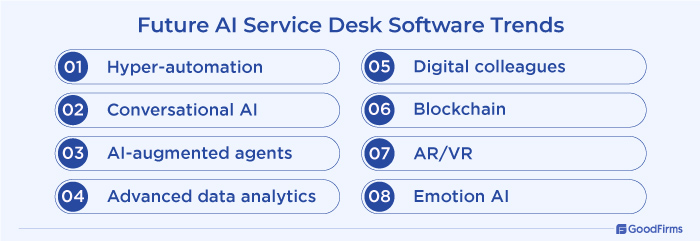
Latest technological developments, such as hyper-automation, conversational AI, AI-augmented agents, advanced data analytics, digital colleagues, Blockchain, AR/VR, emotion AI, etc., will further automate more complex tasks, understand the intent behind user queries, enable preemptive resolutions, improve employee satisfaction, ensure optimal cybersecurity, and make the IT support more personalized and efficient.
Additionally, the ongoing advancements and experiments in AI algorithms would lead to the introduction of new features that can cohesively elevate the employee experience, human-like interactions, cost efficiency, and scalability to meet the growing service desk and business needs consistently.
Conclusion
“As artificial intelligence evolves, we must remember that its power lies not in replacing human intelligence, but in augmenting it. The true potential of AI lies in its ability to amplify human creativity and ingenuity.” - Ginni Rometty, Former CEO, IBM
AI-backed service desk software solutions are not just tools rather, they are a boon for businesses having longer response and resolution times. Adopting an AI-backed service desk solution can significantly reduce the resolution times by up to 50%, transforming the way businesses used to traditionally carry out their service desk and IT service management functions. In this modern and busy era, implementing an AI-backed service desk solution isn't just about faster IT support, but its main purpose is to align the modern service desk processes with the dynamic user requirements and business expectations. As the world is making significant progress in the advancements of emerging technologies like AI and ML, the capabilities and functionalities of these systems are only going to improve in the future, making it more smarter, faster, scalable, and streamlined to ensure service desk teams can optimally perform their roles and functions. Not only premium tools, but the free and open source service desk systems are also being equipped with AI features to meet modern requirements.


.jpg)