“If you are running a business, there are three things to focus on - quick service delivery, attentive service delivery and efficient service delivery”
Over the past few decades, service has become a catchphrase for all businesses. Service delivery is the survival factor, and anything below the expectation can be disruptive. Every business stakeholder whether employees, customers, partners, suppliers, or others expect instant resolution of issues. It is often termed as First Call Resolution, i.e., one of the primary metrics that determine the effectiveness of a service desk operation. Higher first call resolution rates means efficient service desk operations, which ultimately lead to improved user satisfaction and reduced operational costs. However, achieving this is not easy, rather it comes with tons of challenges such as high ticket volumes, repetitive tasks, complex IT environments, high resolution times, etc. These challenges can lead to increased wait times, frustrated users, and higher operational costs if not managed properly on time.
Here, a service desk software comes in handy, helping businesses seamlessly manage IT operations and instantly resolve service desk and IT-related issues. Modern AI-powered service desk solutions are designed to streamline operations, automate monotonous tasks, and provide robust features to quickly identify, track, and resolve issues. Not only this, but the modern service desk software systems offer advanced features like AI-driven automation, multi-channel support, knowledge management systems, real-time analytics, and more, allowing service desk teams to handle issues more efficiently and effectively.
This article highlights and compares the cost and features of the top service desk software currently dominating the market. The blog also aims to provide comprehensive information on the necessary features, their importance, and effects of not having these features in the service desk software. Further, the blog also elaborates the factors that influence the cost of service desk software, to help you make informed decisions while selecting the best service desk software for your business needs.
What is a Service Desk Software?
A service desk software is a system designed for businesses to provide timely assistance to employees, customers, partners, suppliers, and other stakeholders, regarding their IT issues, inquiries, requests, and challenges. It is considered as the backbone of IT support and acts as a single point of contact for incident handling, problem management, service request & ticket management, change management, troubleshooting, self-service, etc. It comes integrated with the features of customer service software and a help desk system, allowing businesses to efficiently perform all these different tasks from a centralized tool without wasting much effort and resources.
History and Evolution of Service Desk Software
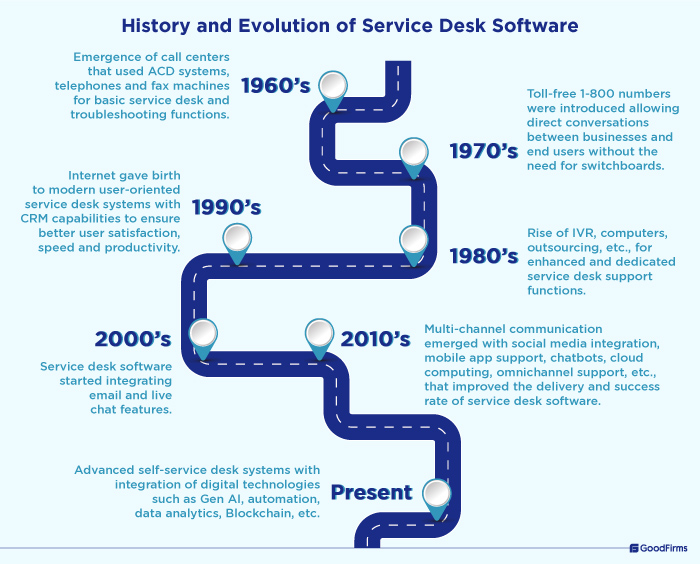
The history of modern service desk software systems dates back to the 1960s when call centers with ACD systems, telephones, and fax machines were introduced to perform basic service desk functions. Eventually, toll-free 1-800 numbers, IVR, computers, outsourcing, etc., came into practice, eliminating the need for switchboards in direct conversations between businesses and end users.
Over the time, vendors developed and upgraded the existing service desk software to implement new features and capabilities. Then in the 1990s, the internet became widely popular that led to the foundation of modern user-oriented service desk systems with CRM capabilities to ensure better user satisfaction, speed, and productivity. With the improvement of the internet speed, email, and live chat features, service desk functionality has matured to include streamlined communication and collaboration in real-time.
Further with technological innovation, multichannel communication emerged with social media integration, mobile app support, chatbots, cloud computing, omnichannel support, etc., to improve the delivery and success rate of service desk software. Ongoing development in digital technologies such as Gen AI, automation, data analytics, blockchain, etc., will further propel the growth of service desk tools in the near future.
Types of Service Desk
Local Service Desk Software
A local service desk is an on-premise system that exists within a business workplace or location, and acts as a single point of contact (SPOC). It is one of the most valued among service desk systems when it comes to immediate on-site resolution of issues. Local service desks can handle only a limited number of service requests at a time. Customers and employees can physically visit the local IT service desk and resolve their issues in a hassle free manner.
Remote Service Desk Software
A remote service desk is a cloud-based system that offers remote technical support from anywhere. It is among the most flexible approaches of the service desk as it enables users to seek service help from a remote location. Whether employees or customers, they can get resolution to their issues appropriately through remote help desk services by connecting through multiple channels and tools.
Who Can Use a Service Desk Tool?
All industries use service desk systems to respond to the queries and issues of their business stakeholders, whether customers, employees, partners, or others. Majorly, professionals from critical industries, such as healthcare, education, retail, manufacturing, finance, government, etc., use this tool to manage and resolve their IT issues. Additionally, business professionals from different departments, including IT support, help desk, customer service, service desk, human resources, training and development, etc., use this tool to handle customer inquiries and ensure smooth operational workflows.
Benefits of Service Desk Software
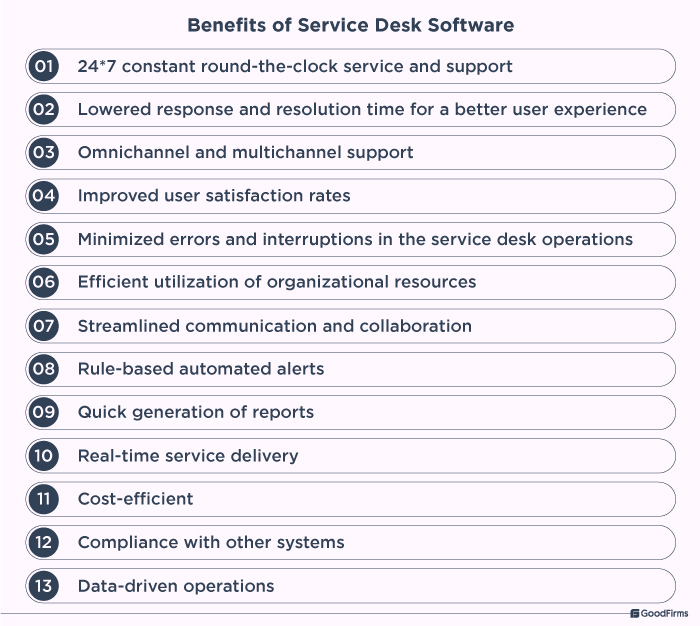
A service desk software offers several benefits to the end users, and they are as listed below;
Top Features of Service Desk Software and Their Importance
Features of a service desk software plays a crucial role in ensuring that the service desk teams can optimally perform their functions and roles. However, businesses often find it difficult to select the features that they need from their service desk software due to lack of proper information. Here are the few notable features of a service desk software along with the importance and issues that may occur without these features;
Artificial Intelligence
Artificial Intelligence is the set of algorithms and models that can be used to automate tasks, prioritize workflows, and serve critical insights to service desk departments. Implementing AI/ML technologies for better customer experience is a priority for around 29.4% respondents of a Goodfirms research. By implementing AI in service desk software, businesses can reduce their operational costs, improve agent productivity, and help quickly resolve the tickets. Absence of AI in the service desk could potentially limit the software from functioning at the full capacity.
Incident management
Incident management is the process of effectively responding to unplanned events, situations, and service disruptions to restore them to an optimal state. It is important for businesses in reducing the downtime, minimizing impact on agent productivity, and documenting and tracking the incidents to identify trends. If this feature is not available in the service desk software, then businesses can experience issues associated with accessing past records of incidents, identifying trends, transparency on incident status, etc.
Self-service portal
Self-service portal is a platform designed for users to resolve their issues independently using self-service resources and searchable databases. It is an established fact that users prefer self-service when using any customer service software. It is very important in service desk software as it enables users to quickly search for the answers to their questions while eliminating the need for human intervention. The absence of self-service in service desk tools could add to the additional burden on the employees, which also increases the response and resolution times.
SLA management
Service level agreement or SLA management refers to the process of managing relevant terms, conditions, and policies regarding the quality, responsibilities, and availability of the services between service providers and users. It is beneficial for service desk teams in stating and tracking the relevant situations and events for which service desk services are available. Without SLA management in place, businesses may fail to specify the relevant terms and conditions and may have to provide support to users whenever they request, at any time, in any situation.
Multichannel support
Multiple communication channels, such as chat, email, phone, social media, etc., are needed and leveraged by businesses to resolve the issues of employees and customers. Studies indicate that customer satisfaction (CSAT) reaches 67% with smooth omnichannel support. It is important for businesses in ensuring personalized, efficient, and accessible support whenever needed. Absence of multichannel support in service desk software could lead to miscommunication, user dissatisfaction, poor experience, improper accessibility, and slow problem resolution and response time.
Customizations
Customizations play a crucial role in ensuring better user experience, performance, custom process configurations, and scalability of the service desk software. Without customizations, the software may fail to meet the specific branding, features, user interface requirements, and overall outcomes for the business. These also cover dashboard and visualizations customizations.
Automation
Automation eliminates the monotonous and time-consuming tasks, allowing human representatives to focus on other critical operations that require their assistance. In the service desk tool, tasks such as ticket assigning, alerts, reporting, etc., can be automated. Without automation capabilities, numerous routine service desk tasks are done manually, which negatively impacts the agent’s workload and performance and increases business costs.
Integration
This feature is important for service desk software in ensuring seamless integration with other organizational tools and software aimed at unlocking new capabilities and features for better tracking, reporting, and collaboration. Lack of proper integration features will result in fragmented information, inefficiencies, increased errors, miscommunication, etc.
Ticket management
Ticket management refers to the process of managing, assigning, prioritizing, and optimizing incoming or outgoing requests from customers and employees. A service desk ticketing system helps businesses with ticket load balancing and tracking, monitoring agent performance, and acquiring full context/summary. Without the features of the ticketing system in service desk tools, businesses can experience issues with triage, metrics assessment, escalation paths, ticket history, and more, resulting in low accountability and reduced performance.
Asset management
Asset management refers to the process of tracking, managing, and optimizing the IT assets that may be of use to the service desk team. It is important in waste elimination, efficient resource utilization, centralized information, and improved asset visibility. If a service desk software lacks IT asset management tools, then businesses may fail to identify poor-performing assets, which means added costs.
Analytics and Reporting
The demand for trustworthy data is rising beyond expectations. In addition, data-driven insights and robust reporting features are very vital to improve support functions. These help track important KPIs, determine bottlenecks, make better decisions, monitor agent performance, etc. Without these AI-powered features in service desk software, businesses cannot properly understand their data and metrics due to which they may make uninformed decisions.
AR/VR
AR/VR technologies either simulate the real world or overlay virtual objects in the physical world for an immersive experience. AR/VR in service desk tools use immersive experiences for remote support and training, troubleshooting hardware issues, and guiding users through complex procedures, reducing risks and errors. If this feature is not available in service desk software, then workers may find it difficult to troubleshoot hardware issues, meaning increased frustration and longer resolution times.
Change Management
Change management is the process of planning, reviewing, approving, and implementing the IT services related changes in a systematic and controlled manner. Change management tools are necessary in service desk software systems to implement change with minimal risk and ensure greater control and visibility over the entire process. Lack of this feature could lead to unauthorized or failed changes, resulting in change collisions and emergence of new emergency changes.
CMDB
A CMDB or configuration management database stores all the relevant information of IT-based software and hardware components. It helps businesses find the relationship between different IT components, break configuration items into logical layers, and better plan asset management. Without this feature, businesses suffer from a lack of central reference point for relevant IT information leading to poor transparency and visibility.
Problem Management
Problem management is the process of eliminating unwanted events and situations by detecting and resolving the root cause. In service desk software, it helps reduce resolution time, prevent costly incidents, and promote continuous service improvement to quickly resolve and close the problem. In the absence of this feature, the amount of ticket volumes and mean time to repair increase which often leads to service disruptions and overburden on service desk teams.
Remote Control
Remote control features allow businesses to access and control user devices remotely to troubleshoot and resolve issues without being physically available at the place. It is important in service desk software to quickly and remotely troubleshoot issues. Absence of remote control feature in service desk software makes it impossible for businesses to remotely control, view, or manage the IT assets, resulting in higher resolution time.
Knowledge base
A knowledge base is a centralized repository of articles, research, and other useful sources that can be used by customer support teams, customers, and employees to instantly solve common problems, incidents, and service requests. It optimizes waiting time and cost utilization, and ensures fast resolution. Without a knowledge base in place, a human representative becomes a must and service desk software cannot be immediately used to resolve any issues, even common ones.
Mobile app
A mobile app helps service desk teams to resolve issues from anywhere on the go. Without a mobile app, businesses, customers, and other stakeholders may not be able to easily use the service desk software and resolve the issues whenever needed; rather, the support team needs to be physically available at the workplace 24/7 to use the software for resolution purposes.
Before moving ahead, let’s take a look at Freshservice, a prominent service desk tool to comprehensively manage service desk operations with minimal efforts and resources.
Freshservice
With a 96% customer satisfaction score, Freshservice is an intuitive, AI-powered service desk management software trusted by 73,000+ businesses worldwide to seamlessly manage their service desk operations. Employees, IT leaders, and service desk professionals can use this software to proactively monitor, improve self-service capabilities, automate front-line assistance, provide human-like context-aware support, and much more. This AI-powered tool engages and adapts specifically to business needs, and is available in multiple portal languages, and supports integrations with Slack and Microsoft Teams. Freshservice is available for a 14-day free trial.
List of the Top Service Desk Software
ManageEngine ServiceDesk Plus
With 20+ years of IT service management excellence, ManageEngine ServiceDesk Plus is a well-known, scalable, and secure service management platform designed to easily automate, scale, and manage service desk functions for both IT and non-IT teams. It offers multiple deployment models, 360° approach to service management, a multi-instance model, last mile customizations, and privacy-first design, making it a perfect fit for leading industries like retail, education, government, healthcare, and manufacturing. Business giants like Honda, Disney, Siemens, Xerox, etc., use this tool to manage and meet their service desk requirements. It also comes integrated with robust AI and automation capabilities to perform rule-based actions, automatically assign tickets, request ticket lifecycle, get smart notifications, and alerts, manage micro-tasks, leverage voice chat, and more. Other notable features of ManageEngine ServiceDesk Plus include full-stack IT service management, self-service, asset management, native IT integrations, 3rd party business integrations, intuitive dashboards, and insightful reports. The company allows a free demo for the software.
Zendesk Support
Zendesk Support is an AI-powered service desk software trusted by 100,000+ companies for offering an unprecedented level of personalization, flexibility, and scalability. One of the top features of Zendesk Support is Zendesk AI agents that leverage billions of real customer service interactions to offer response suggestions, send personalized replies, empower agents with full context, automatically route incoming interactions, provide actionable insights, and automate various other repetitive tasks. In addition, features like multi-channel messaging, smart knowledge base, powerful ticketing system, self-service, superpowered customizations, 24*7 service, AI-driven workforce engagement management, and 100’s of integrations makes it a perfect service desk option for big enterprises, SMBs, and startups. There are multiple packages available for Zendesk Support, starting from USD 19 per agent per month.
Jira Service Desk
Another top service desk software is Jira Service Desk that comes with exceptional functionalities to quickly help employees and customers solve their grievances. Business teams, IT support, and customer service teams widely use this software for change management, request management, incident management, problem management, and asset management. The software offers an intuitive self-service portal and a rich knowledge base of resources to resolve incoming requests promptly. In addition, it also comes with conversational ticketing, incident management, SLA management, and an advanced ticketing system to track, triage, and assign tickets from different sources. Additionally, the Jira Service Desk system comes with advanced report and dashboard creation features to view relevant metrics, collect feedback, understand the customers, monitor teamwork, optimize performance, and much more. Jira Service Desk software offers a free version allowing up to 3 agents.
Solarwinds Service Desk
Solarwinds Service Desk is an AI-powered, comprehensive ITIL-ready service management platform designed to streamline IT support and services for businesses with problem management, incident management, change management, and release management features to efficiently meet end user needs. The software can automate critical ticket management tasks such as ticket routing, classification, correlation, and more. It comes with essential service desk functions such as self-service, IT asset management, service catalog, REST APIs, customizable reports, CSAT score, SLA management, audit history, benchmarking, risk detection, and enterprise service management to improve productivity and response time. The software allows seamless integrations with Team Viewer, Jira, Google Apps, Zendesk, Slack, Dropbox, and many more platforms for better scalability and flexibility. The company allows a 30-day free trial for Solarwinds Service Desk.
ProProfs Help Desk
ProProfs Help Desk is another leading tool that helps streamline the service desk operations of high-performance IT and customer support teams. The software is especially valuable to SMBs and big corporations owing to features like advanced ticket assignment, canned responses, automated alerts, easy-to-use UI, multichannel support, shared inboxes, KPI tracking, team performance evaluation, CSAT score, custom field creation, live chat, and many more. It also comes equipped with knowledge base, CX feedback, survey maker, agent collision detection, real-time chat support, file transfer, 24*7 support, child ticket reporting, and external integrations to improve agent efficiency, deliver enhanced experiences, and respond to and resolve issues faster. The software offers a free plan that allows a single user apart from multiple paid plans.
SysAid
SysAid is an innovative Gen AI-based service desk software to improve mean time to repair, deliver better experiences, and automate service desk workflows. The software is a perfect tool for midsize teams to large IT departments for its versatile features, including asset management, AI-powered conversational chatbot, self-service, ticket management, comprehensive insights, forecasts, recommendations, sentiment analysis, workflow orchestration, and many more functions. Among the unique features of this tool is SysAid Copilot that is beneficial for businesses for smart ticket handling with automated ticket categorization and routing, acquiring case summaries, prioritizing ticket, response rating, fine-tuning, and getting AI insights to ensure consumer grade support and service.
LiveAgent
Another renowned name in the list of top service desk software is LiveAgent that is popular among the users for its best-in-class communication features. The software offers LiveAgent ticketing, multichannel support, knowledge base, agent collision detection, automated ticket distribution, and canned messages features to help businesses unlock a new level of efficiency and productivity in service desk operations. It also provides advanced features like live chat software with LiveAgent AI chatbot for quick and efficient resolution of issues and prevent miscommunication. Additionally, the tool offers unique features such as GIFs in tickets, hybrid ticket stream, SPAM filters, time tracking, WYSIWYG editor, proactive chat invitations, automated callback, channel reports, and 200+ integrations to improve your service delivery, sales, and customer satisfaction rates.
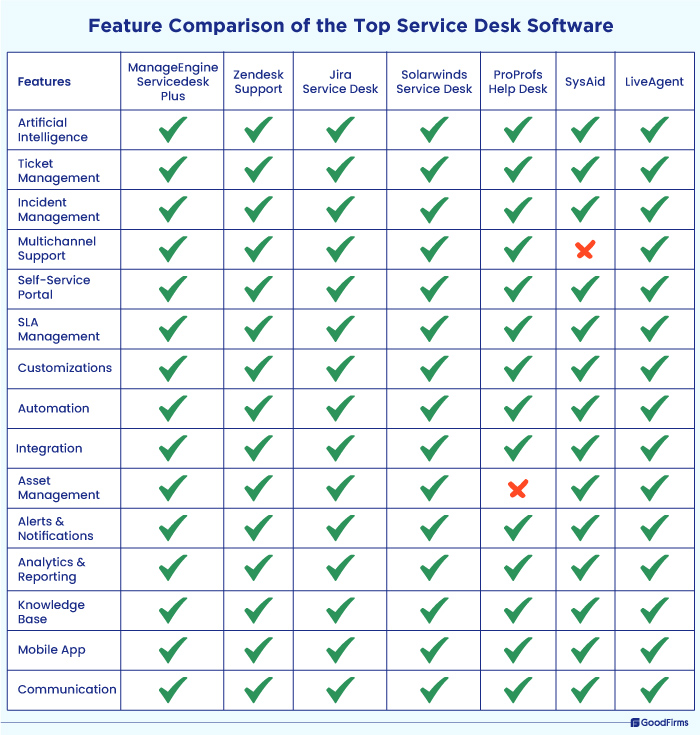
Feature Comparison of the Top Service Desk Software
The feature comparison of the top service desk software is as follows;
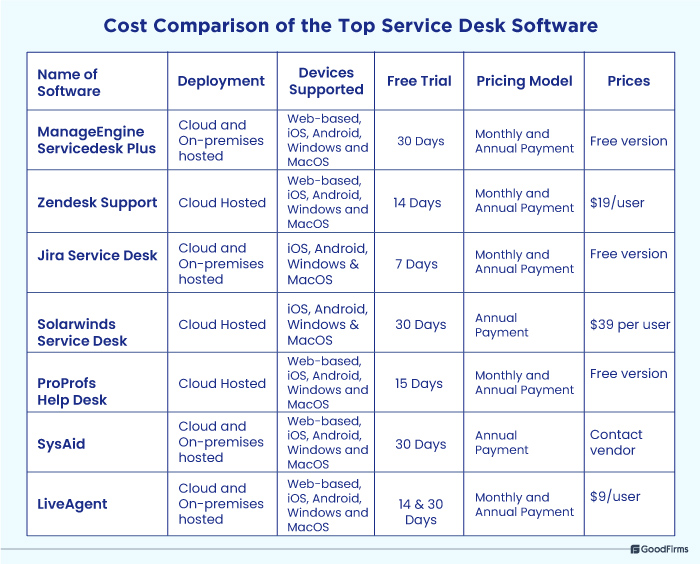
Cost Comparison of the Top Service Desk Software
The cost comparison of the top service desk software along with the supported deployment type, device type, free trial, pricing, etc., is as follows;
Factors That Influence the Cost of Service Desk Software
The cost of service desk software varies significantly based on various factors. Some of these factors are discussed below;
Features
Features are among the most influential factors when it comes to costs of a service desk software. Most service desk software offers basic features, and extra costs may incur when integrating advanced features that are not readily available. Knowledge base, self service, AI integration, multiple communication channels, SLAs, asset management, automation, and reporting are common features that impact the costs of service desk tools.
Security
Cybersecurity is a top priority for businesses worldwide. A typical service desk software comes with basic security features to register, sign in, and manage profiles. Implementation of advanced security features like multiple registration options, social sign in, AI-powered security algorithms, robust access controls and permission, regulatory compliance, etc., remarkably adds to the costs.
Integrations
Integrations help the service desk software connect with other external business applications and systems to ensure real-time connectivity for easy ticket resolution. Businesses must check out the integration capabilities and relevant charges based on their specific integration needs, to determine the influence of integrations on the overall costs. Further, you must choose a service desk tool with proper integration capabilities to ensure better productivity and RoI.
Customizations
Customizations in the software plays a vital part in ensuring user experience, performance, and scalability of service desk software, apart from fulfilling the specific user needs. Common service desk customizations include UX/UI, features, content, graphics, and more.
Number of users/devices/support agents/tickets
Another factor that is considered in setting the costs of service desk software is the number of users/devices/support agents/tickets that the tool must support. More users means more costs and few users means few costs.
Support and maintenance
Post deployment support and maintenance offered by the service desk system provider, also influence the costs of the service help desk software. The vendors typically offer post deployment support and maintenance covering regular updates, bug fixes, feature add-on/removal, technological modifications, and more, for the efficient functioning of the software, and charge accordingly based on the type and level of services offered.
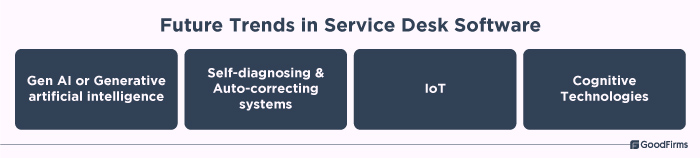
What Are the Future Trends in Service Desk Software?
Gen AI or Generative artificial intelligence
Gen AI is among the leading customer experience trends with almost 70% business leaders planning to integrate it into their operations. Gen AI could transform many aspects of service desk functions such as chat-based customer support, email communication, search functionality, voice-based interactions, etc., unlocking a whole new level of performance, productivity, and efficiency for the agents as well as businesses.
Self-diagnosing and Auto-correcting systems
Self-diagnosing and correcting systems can autonomously identify and resolve the potential problems on their own to reduce downtime and improve system reliability. These systems are rapidly being deployed by the businesses in service desk systems to ensure proper functioning and optimization of maintenance operations. These systems generally rely on AI and machine learning algorithms that can learn from past incidents to improve their diagnostic accuracy and correction capabilities over time, leading to faster problem resolution.
IoT
The global Internet of Things (IoT) market is expected to rise to more than USD 908 billion by 2034, meaning more interconnected devices and networks. The Internet of Things has the potential to improve many aspects of service desk software in the upcoming years. These include IT asset management, configuration management, analytics, performance monitoring, risk management, downtime reduction, etc., eliminating the errors and risks involved while ensuring higher connectivity and greater flexibility. IoT-enabled systems can send alerts to the service desk when any issue is detected, enabling proactive maintenance for reducing the service disruptions.
Cognitive Technologies
Cognitive automation refers to the combination of technologies like AI with process automation to improve organizational results, efficiency, and decision making. While RPA and chatbots are already transforming customer service, cognitive automation technology is becoming mainstream in service desk operations by serving users with most relevant knowledge base articles, automatically closing the tickets upon marking, recommending risk levels in change management, automatically analyzing the root cause for problem investigations, and many more functions. In the future, it will further strengthen the trust of businesses in data through performance analytics, reporting, integration, sentiment analysis, and more, ensuring better service desk operability, resolution times, and issue tracking.
Conclusion
Business organizations of all sizes and types use service desk software to enhance their IT support systems, make informed decisions, and proactively transform the service desk. The future of services desk software looks promising owing to the advancements in digital technologies such as Generative AI, cognitive automation, IoT, and self-diagnosing systems which will further improve the response and resolution times. These technologies will also help in implementing advanced features and security measures in service desk tools that will allow the managers to easily navigate through service desk complexities, ensuring robust cybersecurity and seamless transition from traditional to automated systems. Further, technologies like machine learning, natural language processing, RPA, and blockchain could further revolutionize the service desk operations, humanize technology, and enable more accurate responses and quick issue resolution.


.jpg)